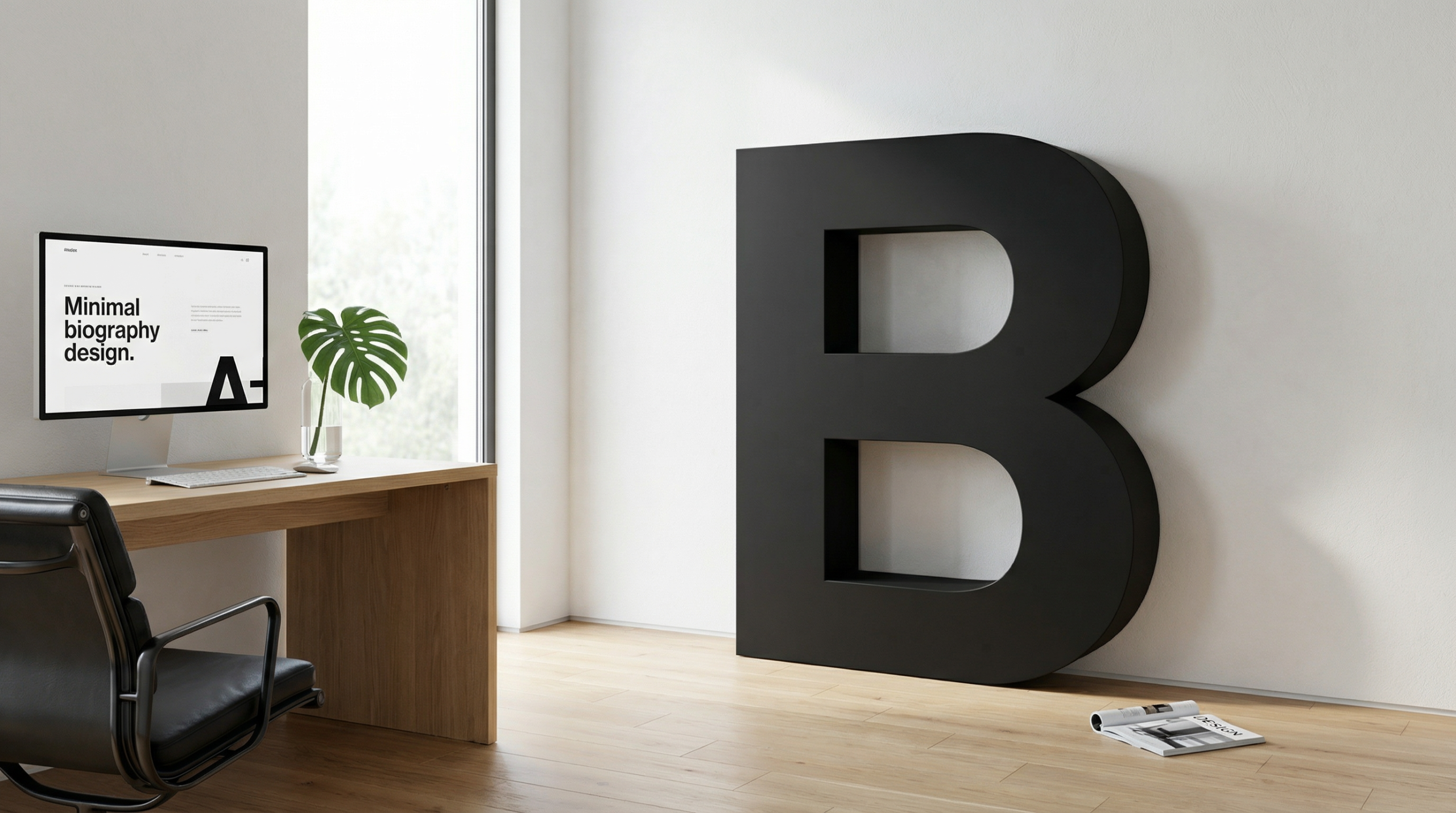
How the fusion of expressive typefaces and clean aesthetics is reshaping the web — and what it means for businesses ready to stand out
There’s something happening in web design right now that feels both fresh and oddly familiar. It’s like we’ve collectively exhaled after years of cramming every pixel with content, animations, pop-ups, and competing calls-to-action. We’ve stepped back, taken a breath, and remembered something fundamental: sometimes, the boldest statement is the simplest one.
I was scrolling through a client’s competitor analysis last month when it hit me. Site after site featured the same cluttered layouts — sidebars stuffed with widgets, hero sections drowning in text, navigation menus that needed their own navigation menus. And then I landed on one that stopped me cold. A single word. Massive. Taking up nearly the entire viewport. White space around it like a frame. And suddenly, I was paying attention.
That’s the power we’re talking about here. Bold typography paired with minimal, clean design isn’t just another fleeting trend — it’s a fundamental shift in how we think about communication on the web. It’s the marriage of confidence and restraint, personality and clarity, impact and simplicity.
And for businesses trying to cut through the noise of an increasingly crowded digital landscape? This approach might just be the secret weapon they’ve been looking for.
Let’s dive deep into this design philosophy, explore why it’s experiencing such a powerful resurgence, and understand how MetaV8Solutions and our clients can leverage it to build web experiences that don’t just exist — they command attention.
The Return of Less: Why Now?
You’d think we’d learned this lesson by now. Minimalism in design isn’t exactly a new concept. From the Bauhaus movement to Apple’s iconic product design, the principle of “less is more” has been preached for decades. So why are we talking about it like it’s some revolutionary insight in 2024?
Here’s the honest answer: we got distracted.
The explosion of digital capabilities over the past decade created a kind of design arms race. When everyone suddenly had access to parallax scrolling, we all started using parallax scrolling. When micro-animations became possible, every button needed to dance. When we could embed video backgrounds, you better believe we embedded video backgrounds — even when they slowed sites to a crawl and confused more visitors than they impressed.
The tools became the master. Technology started driving design decisions instead of human needs.
But something shifted. Maybe it was pandemic-induced screen fatigue. Maybe it was the collective realization that we were all spending so much time online that we couldn’t handle the visual chaos anymore. Maybe it was watching conversion rates climb on sites that respected their visitors enough to get to the point.
Whatever the cause, the effect is clear: there’s a hunger for digital spaces that feel calm, confident, and intentional. Spaces where typography carries the emotional weight instead of a dozen competing visual elements. Spaces where every design choice feels deliberate.
And here’s what makes this iteration different from the minimalism of the past: it’s not cold. It’s not sterile. The bold typography component injects personality, warmth, and human expression into the clean canvas. It’s minimal, but it’s definitely not boring.
What Exactly Are We Talking About? Defining the Trend
Before we go further, let’s get specific about what this design approach actually encompasses. Because “bold typography” and “minimal design” can mean different things to different people.
The Bold Typography Side
When we talk about bold typography in this context, we’re looking at several key characteristics:
Oversized fonts: Headers that demand attention. We’re not talking about bumping up your H1 from 36px to 42px. We’re talking about type that’s unapologetically massive — sometimes 150px, 200px, or even larger on desktop screens. Text that isn’t afraid to take up space.
Creative typefaces: Moving beyond the safe, predictable web fonts we’ve defaulted to for years. This means exploring serifs with personality, experimental sans-serifs, display fonts that make a statement, and even custom typefaces that become part of a brand’s identity.
High-contrast text: Sharp distinctions between light and dark, between heavy and thin weights, between different font sizes. No muddy middle ground. When text appears on the page, it appears with purpose.
Typography as a visual element: Treating text not just as content to be read but as a design component in itself. Letters that interact with other visual elements. Words that become imagery. Headlines that double as graphic design.
Variable fonts and dynamic type: Taking advantage of modern browser capabilities to create typography that responds, shifts, and adapts — without sacrificing performance.
The Minimal / Clean Design Side
And on the minimalist side of the equation:
Generous whitespace: Or negative space, if we’re being technical. Room to breathe. Not every pixel needs to be filled. In fact, the empty space often communicates as much as the content itself.
Reduced element count: Ruthless editing of what makes it onto the page. Fewer images. Fewer sections. Fewer distractions. Everything that remains has earned its place.
Intentional color palettes: Often limited to two or three colors, sometimes even monochromatic. When color is used, it’s purposeful.
Streamlined navigation: Simple, clear paths through the site. No mystery meat navigation or hidden hamburger menus with seventeen nested items.
Content hierarchy that’s immediately obvious: Within seconds of landing on any page, visitors know what’s most important and where to look.
When these two approaches combine — bold, expressive typography placed within a clean, uncluttered layout — something magical happens. You get clarity and impact. Simplicity with personality. A design that’s restrained but never boring.
The Psychology at Play: Why This Combination Works
Let’s get a little nerdy for a moment, because the effectiveness of this design approach isn’t arbitrary. There’s real cognitive science behind why bold typography on minimal backgrounds connects with users so effectively.
Cognitive Load and Decision Fatigue
Every element on a webpage demands some degree of mental processing from your visitor. Images need to be interpreted. Navigation options need to be evaluated. Competing calls-to-action need to be weighed. The more elements, the higher the cognitive load.
And here’s the uncomfortable truth: our visitors don’t have unlimited mental energy to spend on our websites. They’re probably looking at your site while also checking email, half-listening to a meeting, and wondering what to make for dinner. They’re not giving you their undivided attention — and honestly, they shouldn’t have to.
When you strip away the unnecessary elements and let bold typography carry the message, you’re reducing cognitive load dramatically. The brain isn’t jumping between dozens of competing elements. It’s receiving a clear signal: here’s what matters, here’s what I need you to understand.
Decision fatigue is real. When presented with too many options, people often choose nothing at all. By simplifying the visual landscape, we’re making it easier for visitors to take action.
The Von Restorff Effect
Also known as the “isolation effect,” this principle states that items that stand out from their surroundings are more likely to be remembered. When a bold headline sits against a minimal background, it’s not competing for attention — it has it all.
This is why the combination works better than either element alone. Bold typography on a busy background just adds to the noise. Minimal design without any focal point feels empty and forgettable. But bold typography on a minimal canvas? That headline isn’t just visible — it’s memorable.
Trust and Perceived Competence
Here’s something interesting: research consistently shows that clean, well-organized design increases perceived trustworthiness. When a website looks cluttered or chaotic, visitors subconsciously question the professionalism of the business behind it. When it looks clean and intentional, credibility increases.
Bold typography reinforces this by projecting confidence. Companies that are sure of their message can say it loud. Companies unsure of their value proposition tend to hedge, qualify, and clutter.
Emotional Response and First Impressions
We form impressions of websites in milliseconds. Not seconds — milliseconds. In that brief window, visitors are making judgments about whether your site is worth their time, whether your company is trustworthy, whether you have what they need.
Clean design with bold typography creates an immediate emotional response: confidence, clarity, professionalism. That first impression colors everything that follows. Start strong, and visitors are primed to engage. Start chaotic, and you’re fighting uphill from the first moment.
The Elements in Detail: Mastering Each Component
Let’s break down the individual elements that make this design approach work, and explore how to execute each one effectively.
Oversized Typography
The first time you spec out a 180px headline, it’s going to feel wrong. That’s normal. We’ve been conditioned to think of text at certain conventional sizes. Breaking that convention requires courage.
But here’s why it works: oversized typography creates an immediate focal point. There’s no ambiguity about what’s important. The eye goes directly where you want it.
However, scale alone isn’t enough. Effective oversized typography requires:
Careful copywriting: When your headline is that prominent, every word matters. You don’t have room for filler. The best oversized headlines are short, punchy, and impossible to misunderstand.
Responsive consideration: A 180px headline on a 27-inch monitor looks commanding. The same headline on a mobile phone is a mess. Truly effective oversized typography scales thoughtfully across devices, maintaining impact without breaking the layout.
Typographic quality: Cheap fonts fall apart at large sizes. The curves get awkward, the spacing looks off, and the overall impression suffers. Quality typefaces — whether free or licensed — are non-negotiable when you’re putting type front and center.
White space partnership: Oversized typography needs room to breathe. Crowd it with other elements and you lose the power. Surround it with space and it becomes even more impactful.
Creative Typeface Selection
For years, the web typography conversation was dominated by two considerations: availability and readability. We chose from a limited palette of web-safe fonts, or we used early web font services and hoped for decent performance.
That landscape has changed dramatically. Today, we have access to thousands of quality typefaces optimized for web use. Variable fonts have revolutionized performance and flexibility. And browser support for advanced typographic features has never been better.
This means typeface selection can become a genuine design decision, not just a technical one.
When choosing typefaces for bold, minimal designs:
Consider brand alignment: Typography carries personality. A geometric sans-serif says something different than a humanist serif. A retro display font creates a different mood than a clean, modern grotesque. The typeface should feel like a natural expression of the brand’s character.
Think about versatility: You’ll likely need your typeface to work at multiple sizes and weights. A beautiful display font might fall apart at small sizes. Make sure your choice can handle the full range of use cases.
Test for distinctiveness: If you’re making typography a central design element, it should be distinctive enough to be memorable. The goal isn’t to choose the most unusual font you can find — it’s to choose one that’s recognizable and ownable.
Evaluate readability under stress: Test your typeface at the sizes you’ll use, in the colors you’ll use, on the backgrounds you’ll use, on various devices. What looks great in a font preview can struggle in the real world.
High-Contrast Text
Contrast is a fundamental design principle, but in this context, we’re pushing it further than typical guidelines suggest.
High-contrast typography might include:
Pure black on pure white: Instead of the softer gray-on-gray that’s been popular in recent years, embracing the full spectrum creates visual punch.
Bold weight variation: Mixing ultra-light and ultra-heavy weights within the same design creates dramatic hierarchy.
Scale contrast: Significant differences between headline sizes and body text, creating clear visual levels.
Color contrast: When color is used, it’s intentional and stark — not pastels fading into backgrounds.
The key is using contrast purposefully. Every contrast point should serve communication, creating a hierarchy that guides attention through the content.
Strategic White Space
White space — or negative space — is perhaps the most underrated element in web design. It takes confidence to leave areas empty when every stakeholder wants to add “just one more thing” to the page.
But white space isn’t empty. It’s working. It provides:
Visual rest: Give the eye a place to pause and process information.
Focus enhancement: Surrounding important elements with space draws attention to them.
Implied quality: Luxury brands have known this forever — space conveys value. It says “we don’t need to cram everything in because what we’re showing you is worth your full attention.”
Improved comprehension: Research shows that appropriate white space between lines and around text blocks improves reading comprehension by up to 20%.
The challenge is defending white space in the design process. There’s always pressure to fill it. Resist.
Content Reduction
Here’s where the hard conversations happen. Because minimal design isn’t just about visual aesthetics — it’s about making difficult decisions about what to include and, more importantly, what to leave out.
Every element on your page should be able to answer: “What purpose do I serve?”
Stock photos that add nothing? Gone. Lengthy paragraphs that could be crisp sentences? Edited. Testimonial carousels that no one reads? Reconsidered. Navigation items that see minimal traffic? Removed or reorganized.
Content reduction requires:
Clear understanding of user goals: What are people actually trying to accomplish on your site? Everything that helps them accomplish it stays. Everything else is questioned.
Honest conversion analysis: Which elements are actually contributing to your goals? Data should inform these decisions, not assumptions or politics.
Willingness to iterate: You don’t have to remove everything at once. Test reductions. See what improves, what doesn’t matter, what actually does hurt. Learn and adjust.
This process can be uncomfortable, especially for organizations accustomed to packing every page with information. But the payoff — in clarity, performance, and conversion — is worth the discomfort.
Real-World Success Stories
Theory is great, but let’s look at how this approach plays out in practice. These examples demonstrate the principles in action, proving that bold typography and minimal design deliver results across industries.
Apple
No surprise here — Apple has been a champion of this approach for decades. But look at their current website and see how they’ve refined it even further. Product pages often feature a single image and a short, punchy headline in large type. The latest iPhone page doesn’t overwhelm with specs and features initially — it leads with an emotional statement and stunning imagery, trusting that interested visitors will scroll for details.
The result? A site that feels premium, confident, and focused. You know exactly what they’re selling and why it matters. Apple doesn’t compete on price; they compete on perception. And their minimal, bold design reinforces that premium positioning with every pixel.
Medium
The blogging platform built its entire brand around typography and reading experience. Large, beautiful serif headlines. Generous line spacing. Minimal navigation. Vast margins. Reading an article on Medium feels different than reading the same content on a cluttered news site — and that’s entirely by design.
By stripping away the visual noise, Medium allows content to take center stage. The platform became synonymous with quality writing in part because it feels like quality writing when you’re reading it.
Stripe
For a financial technology company dealing in complex products, Stripe’s design is remarkably restrained. Clean layouts, bold headlines, plenty of white space. They communicate sophistication and trustworthiness not through busy design but through confident simplicity.
Look at their homepage. A strong headline. A clear value proposition. A single call-to-action. The complexity is there if you want it — detailed documentation, deep product information — but it’s not thrown at you immediately. You’re eased in.
Various Agency and Portfolio Sites
Some of the most striking examples of this trend live in the agency and portfolio space, where designers are free to push boundaries. Sites like Awwwards showcase countless examples of bold typography married to minimal layouts — interactive type, experimental arrangements, and fearless use of scale.
While not every approach is appropriate for every client, these experimental sites demonstrate the possibilities and often signal where mainstream design will head next.
Benefits Beyond Aesthetics: The Business Case
Let’s talk business. Because design decisions are ultimately business decisions, and this approach needs to deliver more than just visual appeal.
Improved Performance
Minimal design with bold typography is inherently lightweight. Fewer images to load. Fewer scripts running. Fewer complex layouts for browsers to render. This translates directly to faster page speeds — and faster pages convert better.
Google’s research has shown that as page load time increases from 1 second to 3 seconds, the probability of bounce increases by 32%. Push it to 5 seconds, and bounce probability increases by 90%. Every element you remove isn’t just cleaning up the design — it’s potentially improving your bottom line.
Typography itself is increasingly performant. Variable fonts can replace multiple font files with a single, smaller download. Modern compression techniques have dramatically reduced web font impact. Well-implemented typography can be both beautiful and lightweight.
Enhanced Mobile Experience
On mobile devices — where a majority of web traffic now occurs — minimal design isn’t just preferable. It’s practically necessary.
Small screens simply cannot handle the visual density that might work on desktop. Elements need to be larger, spacing needs to be more generous, and navigation needs to be simpler. Bold typography with minimal layouts is naturally mobile-friendly.
This alignment means responsive design becomes easier to manage. You’re not trying to cram desktop complexity into a mobile frame — the core design approach scales naturally.
Easier Maintenance
Every additional element on your website is something that needs to be maintained. Images become outdated. Widgets break. Animations conflict with browser updates. Plugins require patches.
Simpler sites are easier to maintain. Typography-focused design reduces dependency on images that need updating, complex scripts that need debugging, and third-party elements that need monitoring. The less there is to break, the less there is to fix.
Clearer Messaging
When you’re forced to reduce your content to essentials, you’re forced to clarify your messaging. What do you really want to say? What does your audience actually need to know?
This discipline extends beyond the website itself. The process of creating a bold, minimal site often reveals brand messaging issues that have been papered over by visual complexity. When you can’t hide behind a stock photo, you have to stand behind your words.
Distinctive Branding
In a sea of templated websites, distinctive typography becomes a powerful brand identifier. When your audience can recognize your brand from the typeface alone — as they might with Coca-Cola, The New York Times, or Nike — you’ve achieved something significant.
Custom or carefully selected typography becomes part of the brand asset library, expressing personality in ways that stock imagery never could.
Common Mistakes and How to Avoid Them
This design approach, for all its apparent simplicity, has plenty of pitfalls. Here’s what to watch for.
Mistaking Empty for Minimal
Minimal design isn’t about having less — it’s about having exactly what’s needed. A page with just a headline and nothing else isn’t minimal if users need more information to convert. It’s just incomplete.
True minimalism is surgical. Every element earns its place. What remains is essential, not just sparse.
Choosing Style Over Substance
That gorgeous experimental typeface might look incredible on a portfolio site, but is it readable enough for a legal firm’s service pages? That massive 200px headline might work for a single-word hero, but does it function for a longer product name?
Typography in this approach serves communication first. Style second. When form interferes with function, form needs to yield.
Ignoring Accessibility
High-contrast, large typography might seem inherently accessible, but there are still considerations. Is your text-to-background contrast ratio sufficient? Are your font sizes actually readable, or just visually impressive? Does your layout work with screen readers? Does your color palette accommodate color blindness?
Accessible design and minimal design actually complement each other well — both prioritize clarity. But it requires conscious attention.
Forgetting About Responsive Requirements
That beautifully arranged typographic composition on desktop becomes a nightmare on mobile if you haven’t planned for it. Large type needs to scale. Line lengths need to adjust. The visual hierarchy that works at one breakpoint needs to translate to others.
Start with mobile or at least think mobile from the beginning. Don’t treat responsive as an afterthought.
Sacrificing Performance for Typography
Web fonts impact performance. Too many weights, too many styles, and your elegant design becomes a slow-loading mess. Choose fonts strategically, subset character sets when possible, and implement proper loading strategies (font-display properties, preloading critical fonts, etc.).
The goal is beautiful AND fast, not beautiful but slow.
Following the Trend Blindly
Not every brand should have enormous typography and stark minimal design. Some brands are warm and busy by nature. Some industries require information density. Some audiences expect traditional layouts.
This approach is powerful when it aligns with brand personality and audience expectations. Forced onto an incompatible context, it can feel inauthentic.
Implementation Guide: Bringing It to Life
For teams ready to embrace this design approach, here’s a practical roadmap for implementation.
Phase 1: Strategic Foundation
Before touching design tools, clarify the fundamentals:
What is the primary message? If visitors remember only one thing about each page, what should it be?
Who is the audience? What are their expectations, preferences, and needs?
What are the conversion goals? What actions should visitors take?
How does this align with brand personality? What character should the design express?
These questions should inform every design decision that follows.
Phase 2: Typography Selection
Choose typefaces that will carry the weight of the design:
Audit current typography: What fonts are currently in use? What’s working? What isn’t?
Explore options strategically: Look at typefaces that align with brand personality, work at large sizes, and remain readable at small sizes.
Test in context: Don’t evaluate fonts in isolation. Mock them up in actual design contexts to see how they feel.
Consider licensing: Ensure you have appropriate licenses for web use and anticipated traffic levels.
Plan for performance: Limit the number of weights and styles. Consider variable fonts. Plan loading strategies.
Phase 3: Content Audit and Reduction
Get ruthless about content:
Identify essential content: For each page, what absolutely must be present for users to accomplish their goals?
Cut aggressively: Remove everything that isn’t essential. You can always add back if testing shows it’s needed.
Rewrite for brevity: Long paragraphs become short ones. Sentences become fragments where appropriate. Every word earns its place.
Prioritize hierarchy: With less content, hierarchy becomes clearer. Make sure the most important information is immediately obvious.
Phase 4: Layout Design
Create the visual structure:
Start with white space: Instead of adding space after elements, start with the space and carefully add elements into it.
Establish a clear grid: Minimal design relies on subtle alignment to feel polished. Your grid should be consistent and deliberate.
Design for one focal point per view: What should the eye land on first? Everything else should support that focal point.
Plan responsive behavior: How does every element behave as viewport sizes change? Document this clearly.
Phase 5: Color and Contrast
Apply color with intention:
Limit your palette: Two or three colors is often enough. Add more only if there’s clear purpose.
Maximize contrast where needed: Headlines and primary content should stand out sharply.
Use color sparingly for emphasis: When color is rare, it becomes a powerful tool for drawing attention.
Test across devices and lighting conditions: Colors that work in your studio might struggle on a phone in sunlight.
Phase 6: Technical Implementation
Build for performance and quality:
Implement web fonts properly: Use font-display: swap, preload critical fonts, subset where possible.
Optimize for core web vitals: Minimal design should naturally help here, but verify with testing.
Test typography rendering across browsers: Different browsers and operating systems render fonts differently.
Ensure accessibility compliance: Test with screen readers. Verify contrast ratios. Check keyboard navigation.
Phase 7: Testing and Iteration
Validate and refine:
Gather user feedback: Does the design communicate what you intended? Is the experience intuitive?
Monitor analytics: How does the minimal design affect conversion metrics? Time on page? Bounce rate?
A/B test when possible: Compare new approaches to previous versions with real traffic.
Iterate based on data: Let results guide refinements rather than assumptions.
Typography Trends Within the Trend
Bold typography isn’t monolithic — there are sub-trends worth watching and potentially incorporating.
Variable Fonts
Variable fonts contain the entire range of a typeface’s expressions in a single file. Instead of loading separate files for regular, bold, light, and extended, you load one file and access any variation along defined axes (weight, width, slant, etc.).
For bold, minimal designs, this is transformative. You can animate between weights for hover effects. You can fine-tune typography precisely rather than settling for predefined stops. And you can do all this with better performance than loading multiple traditional font files.
Kinetic Typography
Text that moves — whether on scroll, on hover, or continuously — adds dynamism to minimal layouts without adding visual clutter. Letters that reveal in sequence. Words that react to cursor position. Headlines that shift in response to scroll depth.
When implemented thoughtfully, kinetic typography creates engagement without requiring additional design elements. The typography itself becomes interactive.
Mixed Typeface Compositions
Rather than using a single typeface throughout, some designs are experimenting with intentional contrast between multiple typefaces in close proximity. A serif headline next to a sans-serif subhead. An experimental display font for one word, a clean grotesque for the next.
This requires a skilled hand — too much variety becomes chaotic. But done well, it adds richness while maintaining minimal overall design.
Custom and Bespoke Typography
As brands seek distinctiveness, more are investing in custom typeface design. A proprietary font that no one else can use becomes a powerful brand asset.
While custom typeface development is significant investment, the impact on brand recognition can be substantial. For brands committing to typography-forward design, it’s worth considering.
Extreme Weight Contrast
The increasing availability of fonts with extreme weights — ultra-thin hairlines next to ultra-bold weights — enables dramatic typographic compositions. A 100-weight subhead under a 900-weight headline creates visual tension that commands attention.
Looking Ahead: Evolution of the Trend
Where does this go next? Design trends don’t remain static, and understanding likely evolution helps make forward-thinking decisions today.
Integration with 3D and Spatial Design
As 3D elements become more common on the web, typography is beginning to exist in three-dimensional space. Letters with depth. Headlines that recede into the page. Text that responds to device motion.
Bold typography in minimal layouts provides a perfect canvas for these experiments — the simplicity of the background allows 3D type to truly stand out.
AI-Responsive Typography
Artificial intelligence is beginning to influence real-time design decisions. We may soon see typography that adapts not just to screen size but to user behavior, time of day, reading speed, or countless other variables.
Imagine a headline that presents differently to a first-time visitor than to a returning customer. Or type that adjusts size and weight based on detected reading patterns. The minimal canvas provides space for these dynamic variations.
Increased Personalization
Related to AI influence, typography and layout may increasingly personalize to individual users. What if the typeface itself varied based on user preferences or demographics? What if the hierarchy adjusted based on what the user most wants to see?
Minimal design makes personalization more practical — there are fewer elements to customize, making dynamic variations more manageable.
Sustainability Consideration
Dark mode and reduced visual complexity directly impact energy consumption, particularly on OLED screens. As sustainability becomes a more prominent concern, bold typography on dark backgrounds — a natural extension of this trend — may become preferred for environmental as well as aesthetic reasons.
What This Means for MetaV8Solutions (and Clients)
Here’s where we get specific about application. At MetaV8Solutions, we see these design trends not as passing fads to chase but as directional signals pointing toward better web experiences. They represent an opportunity to differentiate our work and deliver greater value to the businesses we partner with.
Let’s be real about something: there are thousands of web development firms. Many of them can build a WordPress site. Many can implement a template. Many can make functional websites that check the basic boxes.
What separates us isn’t just technical capability — it’s perspective. It’s understanding where the web is heading and building experiences that will still feel current in two years, not just two weeks. These trends offer a roadmap for where to emphasize effort and resources.
Immersive 3D and Interactive Experiences
Bold typography doesn’t have to be static. For clients wanting high engagement and strong branding, we can create 3D and interactive sites where type comes alive. Letters that respond to cursor movement. Headlines that exist in three-dimensional space. Scroll-triggered typographic animations that turn reading into an experience.
This isn’t just about showing off technical capability — it’s about creating memorable brand moments. When a visitor interacts with type that responds to their movements, they’re engaging with the brand in a way that static design never achieves.
We have the capability to build these immersive experiences. The question for each client is whether it aligns with their goals, audience, and brand personality. When it does, the results are extraordinary.
AI-Powered Personalization and Adaptive UI
The minimal design framework is perfect for adaptive interfaces. With fewer elements to manage, we can build AI-powered personalization that adjusts content, hierarchy, and even typography based on user behavior.
Imagine a site that presents a different headline to visitors from different industries. Or navigation that reorganizes based on what individual users most frequently access. Or content density that adjusts based on detected engagement patterns.
We can build smart, dynamic websites that evolve with user behavior — not just static pages that treat every visitor identically. The clean design foundation makes this adaptation cleaner to implement and more noticeable to users.
Ultra-Responsive Design Across All Devices
Bold typography in minimal layouts naturally adapts across screen sizes, but we take this further. Desktop, mobile, tablets, wearables, large-screen displays — we design for the full spectrum of devices people actually use.
Responsive design isn’t just about not breaking on mobile anymore. It’s about optimizing the experience at every size. A headline that’s bold and commanding on desktop should be bold and commanding on mobile — not just shrunk down.
We ensure sites are ultra-responsive, looking intentional and polished across the full range of devices our clients’ audiences actually use. As wearables and new device categories emerge, this capability becomes even more critical.
Clean Design + Bold Typography as Standard Practice
Rather than treating this approach as a specialized option, we’re integrating clean design and bold typography into our standard practices. Every project considers how simplification could improve the experience. Every design explores how typography could carry more of the communication load.
This doesn’t mean every site looks the same — far from it. It means we’re constantly asking: “Is this element earning its place?” and “Could better typography reduce the need for this image or icon?”
The result is sites that balance aesthetics and performance. Beautiful but fast. Distinctive but practical.
Dark Mode, Accessibility, and Ethical Design
Bold typography on clean backgrounds works beautifully in dark mode — and dark mode is increasingly expected by users. We build dark mode support into projects where appropriate, extending the visual identity into both light and dark contexts.
Accessibility isn’t an afterthought in minimal design — it’s a natural fit. Large type is easier to read. High contrast aids visibility. Simplified navigation reduces cognitive load. We ensure our designs meet accessibility standards while advancing aesthetic goals.
Beyond accessibility, we’re committed to ethical design practices and sustainable hosting options. Minimal design means smaller page sizes. Smaller page sizes mean less energy consumption. Combined with sustainable hosting partners, we can offer clients a web presence that’s responsible as well as effective.
This holistic approach — dark mode, accessibility compliance, sustainable practices, ethical design — positions clients’ digital presence for the future, not just the present.
Positioning for Partnership, Not Just Project Work
Here’s the bigger picture: these capabilities position MetaV8Solutions as more than “just another dev shop.” We become a forward-looking partner building tomorrow’s web today.
Clients aren’t just buying a website from us. They’re engaging with a team that understands where digital experiences are heading and can guide them there. They’re getting strategic perspective along with technical execution.
When we recommend bold typography with minimal layouts, we’re not following a trend for trend’s sake. We’re making a strategic recommendation based on how this approach serves the client’s specific goals: faster performance, clearer messaging, better mobile experience, stronger brand differentiation, reduced maintenance burden.
When we suggest immersive 3D elements or AI-powered personalization, we’re offering capabilities that most agencies can’t deliver. We’re expanding what’s possible for our clients’ digital presence.
And when we build in accessibility, sustainability, and ethical design from the start, we’re protecting our clients from future regulatory requirements and social expectations. We’re building sites that work for everyone — not just the easy audiences.
A Practical Framework for Client Conversations
Understanding these trends is one thing. Helping clients navigate them is another. Here’s how we approach conversations about bold typography and minimal design.
Assessing Fit
Not every client should go fully minimal. Our first step is assessing whether this approach aligns with:
Brand personality: Does the brand have the confidence and clarity to pull off bold simplicity? Or does its character suggest a different approach?
Content requirements: Can the necessary information be communicated within a minimal framework? Or does the nature of the business require density?
Audience expectations: What do this brand’s visitors expect? Will minimal design feel innovative or confusing?
Competitive landscape: Is the industry full of cluttered sites (opportunity for differentiation) or already moving toward minimalism (risk of blending in)?
These conversations often reveal as much about messaging and strategy as about design preferences. They’re valuable even when the outcome isn’t a minimal site.
Addressing Common Concerns
Clients new to minimal design often raise predictable concerns:
“We have so much to communicate — how can we go minimal?”
Minimal doesn’t mean content-less. It means prioritized, organized content with clear hierarchy. Everything important can still be present — it just needs to be arranged for clarity rather than density.
“Won’t it look empty or unfinished?”
Empty and minimal are different things. Minimal design feels intentional and confident. Empty design feels incomplete. The difference is in the quality and presence of what remains.
“How will users find what they need?”
Clear information architecture becomes even more important in minimal design. With a well-organized structure and intuitive navigation, users find what they need faster — not slower — than on cluttered sites.
“Our competitors show everything on their homepage.”
Perhaps that’s precisely why their sites aren’t working. Or perhaps there’s industry expectation we need to respect. Either way, “competitors do it” isn’t a reason to follow — it’s an invitation to differentiate.
Building the Business Case
When we recommend minimal design with bold typography, we back it with business benefits:
- Faster page load times (better user experience, SEO, and conversion)
- Improved mobile performance (capturing majority of web traffic effectively)
- Reduced development and maintenance costs (simpler sites cost less to build and maintain)
- Clearer brand communication (no confusion about value proposition)
- Stronger first impressions (premium feel that increases perceived value)
- Better accessibility (meeting legal requirements and serving all audiences)
These aren’t aesthetic arguments — they’re business arguments. Design decisions are business decisions.
Starting Where They Are
For clients not ready for full minimal transformation, we meet them where they are:
- Refresh homepage with bolder typography while keeping other pages traditional
- Implement a key landing page as a minimal test case
- Upgrade typography across the site without wholesale layout changes
- Add dark mode as a user option
- Improve whitespace gradually through content audits
Not every project needs to be revolutionary. Incremental improvement toward cleaner, bolder design is still improvement.
Case Study: Putting It Into Practice
Let me walk through a hypothetical — but realistic — example of how this plays out in practice.
The Client
A B2B software company with a cluttered website that’s accumulated content over five years. Multiple product lines, dozens of blog posts, case studies, whitepapers, integrations, and team bios. The site feels busy and outdated. Conversion rates are below industry benchmarks. Page speed scores are poor.
The Discovery
We start by understanding what actually matters. Analytics show that 70% of visitors land on the homepage and either convert or leave — they rarely go deeper. The products page gets moderate traffic but low conversion. Most of the other content is barely viewed.
User testing reveals that visitors find the value proposition unclear. They can’t quickly articulate what this company does differently. The visual noise makes finding specific information frustrating.
The Strategy
We propose a bold, minimal redesign focused on:
- A homepage that leads with one clear headline — the single most important thing they do for customers, in large, confident typography.
- Dramatic reduction in homepage sections — from twelve to four. Hero. Core value props. Social proof. CTA. That’s it.
- Consolidation of products onto a single, well-organized page with clear comparison and hierarchy.
- Aggressive content archiving — moving rarely-viewed content to a resource library rather than site navigation.
- Bold, custom typography that becomes part of their brand identity, used consistently across digital and print.
- Performance optimization — the smaller page weights and simplified layouts naturally improve speed.
The Implementation
We select a distinctive typeface that balances professionalism with personality. We write a new homepage headline that’s half the word count but twice as clear. We design with generous white space, high contrast, and confident scale.
The reduced content requirement means faster development. The simpler layout means fewer responsive complications. The performance improvements are dramatic.
The Result
Page speed improves by 40%. Mobile experience transforms from frustrating to seamless. The bounce rate drops by 15%. Conversion rate increases by 22%.
But beyond the numbers, the brand feels different. More premium. More confident. Sales teams report that prospects are coming to calls with clearer understanding of what the company does. The website is no longer a liability — it’s an asset.
The Bigger Picture: Why This Matters Now
Stepping back from tactics and implementation, there’s a reason this design philosophy resonates so deeply right now.
We’re in an era of information overwhelm. Every platform competes for attention. Every brand shouts for visibility. The digital experience for most people is an endless stream of stimulus demanding response.
In this context, simplicity is a gift. Clarity is a service. Confidence is refreshing.
Websites that respect visitors’ time and attention — that communicate clearly without demanding cognitive work — stand out precisely because they’re rare. They feel like a breath of fresh air in a smoggy city.
Bold typography with minimal design isn’t just aesthetically pleasing. It’s a statement about values. It says: “We respect you enough to get to the point. We’re confident enough in our message to let it stand alone. We believe in quality over quantity.”
For businesses trying to build trust with audiences, that’s powerful positioning.
Bringing It All Together
We’ve covered a lot of ground. Let’s bring it back to essentials.
Bold typography combined with minimal, clean design represents more than a visual trend. It’s a strategic approach to digital communication that prioritizes:
- Clarity over complexity
- Impact over volume
- Performance over spectacle
- User needs over feature showing
- Confidence over hedge-betting
For businesses, this translates to faster sites, clearer messaging, better mobile experiences, stronger branding, and higher conversion rates. The business case is as strong as the aesthetic case.
For MetaV8Solutions, this represents an opportunity to deliver exceptional value to clients. We’re not just building sites — we’re building digital experiences that respect users, communicate clearly, and perform brilliantly.
We can offer immersive, interactive experiences when engagement calls for it. We can build AI-powered personalization for clients ready for dynamic sites. We ensure ultra-responsive design across every device. We adopt clean, bold design as a foundation while adding complexity only when it earns its place. And we integrate dark mode, accessibility, sustainability, and ethical design as standard practices.
This positions us — and our clients — for the web as it’s becoming, not just the web as it was.
The sites we build today should feel right tomorrow. Bold typography on clean layouts has staying power precisely because it aligns with fundamental human needs: clarity, focus, confidence. Trends come and go, but these needs persist.
If your current digital presence feels cluttered, confused, or cluttered — if visitors are bouncing before they understand your value — if your site feels like it’s trying to say everything and communicating nothing — maybe it’s time to embrace the power of less.
Say it loud. Say it clear. Say it bold.
That’s the approach we believe in. That’s what we build. And that’s where the web is heading.
Ready to explore what bold typography and minimal design could do for your brand? MetaV8Solutions brings strategic perspective and technical excellence to every project. Let’s talk about building tomorrow’s web today.
Frequently Asked Questions
Q: What is bold typography in web design?
A: Bold typography in web design refers to the use of oversized fonts, heavy font weights, creative typefaces, and high-contrast text as primary design elements. It involves treating typography not just as content delivery but as a visual focal point that commands attention.
Q: Why is minimal design effective for websites?
A: Minimal design reduces cognitive load, improves page performance, enhances mobile experience, and increases conversion rates. Research shows clean design increases perceived trustworthiness and makes content more memorable.
Q: How does bold typography improve conversions?
A: Bold typography creates immediate visual hierarchy, reduces time to comprehension, and projects brand confidence. Visitors understand value propositions faster, and memorable design increases return visits.
Q: What fonts work best for bold, minimal web design?
A: Geometric and humanist sans-serifs, high-contrast serifs, and variable fonts work well. The key is choosing fonts that look intentional at oversized scales and align with brand personality.
Q: Is minimal web design good for SEO?
A: Yes. Faster page loads improve Core Web Vitals, better mobile experience aids mobile-first indexing, and reduced bounce rates signal quality to search engines.
Q: How much white space should a minimal website have?
A: Generally 40-60% negative space, though the key is intentionality. Research shows appropriate white space improves reading comprehension by up to 20%.
Q: Can minimal design work for content-heavy websites?
A: Yes, through strategic organization, clear hierarchy, progressive disclosure, and scannable content structures. Medium.com is an excellent example.
Q: What are common mistakes with bold typography?
A: Choosing style over readability, too many typefaces, poor responsive scaling, low-quality fonts, ignoring accessibility, and performance sacrifice are common pitfalls.

 🚀 Crafting websites that perform, impress & convert. From sleek designs to full digital strategies, we help brands grow online. 💻 Web Design | SEO | Branding | Hosting | Maintenance. Your 24/7 digital marketing engine starts here.
0 Comments