The Future of Web Design: How AI Is Reshaping Creativity, Workflow, and User Experience
Web design has always evolved alongside technology—from static HTML pages to dynamic CMS-driven ecosystems and now fully interactive, personalized digital experiences. But in the last few years, the shift has accelerated dramatically as artificial intelligence steps into the design world—not as a novelty, but as a genuine partner in creation.
AI isn’t just generating stock images and placeholder copy anymore. It’s analyzing user behavior, automating prototyping, predicting design trends, and enabling designers to build smarter, adaptive digital environments. The question is no longer if AI will reshape the industry—it already has. Now we’re exploring how deep the transformation goes and what it means for designers moving forward.
AI as a Design Partner — Not a Replacement
There’s a persistent misconception that AI will replace designers. In reality, AI is best thought of as a collaborator—a tool that accelerates workflows, eliminates repetitive tasks, and opens new creative possibilities.
-
Instead of manually choosing layout grids, AI can propose optimal structures based on content and industry standards.
-
Rather than spending time resizing elements for responsive design, AI can auto-generate breakpoints.
-
Instead of guessing what users want, AI can analyze thousands of interactions and recommend UX pathways.
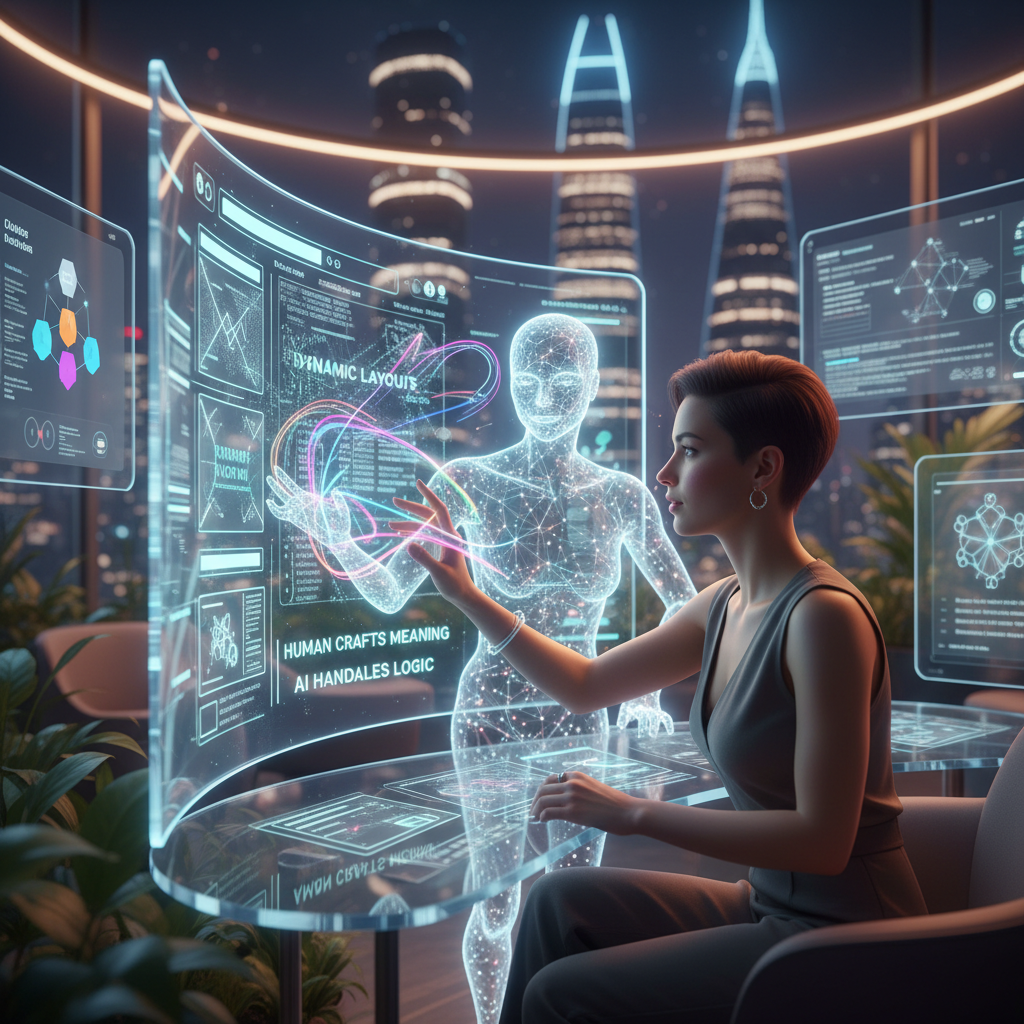
This frees designers to do what machines still can’t: conceptual thinking, emotional expression, brand storytelling, and human-centered problem solving.
AI handles the logic.
Humans craft the meaning.
Hyper-Personalized User Experiences
AI-driven websites are becoming more intuitive and adaptive. Rather than a static experience for every visitor, AI enables:
✔ Dynamic layout adjustments
✔ Personalized content blocks
✔ Predictive navigation
✔ Real-time accessibility enhancements
Imagine opening a website and seeing content tailored to your interests, preferred color scheme, and browsing behavior—automatically. The web is shifting from universal design to personalized digital ecosystems, and AI is the bridge.
Generative Design and Automated Prototyping
Tools like Framer AI, Dorik AI, Elementor AI, and Adobe Firefly are ushering in a new design era where:
-
Wireframes can be generated from text prompts.
-
Images can be created in the exact style required—instantly.
-
Code can be written, refined, and debugged using natural language instructions.
Designers are no longer starting from a blank canvas. They are editing, refining, and collaborating with AI to achieve results faster and with greater precision.
Accessibility by Default
AI is also helping solve a long-standing web problem: accessibility.
Automated contrast checking, live readability analysis, voice-friendly navigation, and adaptive layouts ensure inclusivity isn’t an afterthought—it’s baked into the process.
Websites will increasingly respond not just to who the user is, but to how they engage—whether by touch, mouse, voice, or assistive technology.
The Designer of the Future: A Hybrid Skillset
As AI tools become more powerful, designers are evolving with them. Tomorrow’s web designer will be part strategist, part artist, part technologist.
New essential skills include:
-
Prompt engineering
-
Human–AI collaboration
-
Ethical UI/UX thinking
-
Behavior-driven personalization
-
Automation and workflow optimization
The designers who thrive will be those who embrace AI—not as a shortcut, but as a capability amplifier.
Final Thoughts
The future of web design isn’t machines replacing creativity—it’s creativity enhanced by intelligence. AI is pushing boundaries, expanding imagination, and transforming how we build for the web.
The next chapter of design is not just beautiful or functional—it’s smart, dynamic, human-aware, and infinitely adaptable.
And for designers willing to evolve?
The future is full of possibility.
 🚀 Crafting websites that perform, impress & convert. From sleek designs to full digital strategies, we help brands grow online. 💻 Web Design | SEO | Branding | Hosting | Maintenance. Your 24/7 digital marketing engine starts here.
0 Comments