
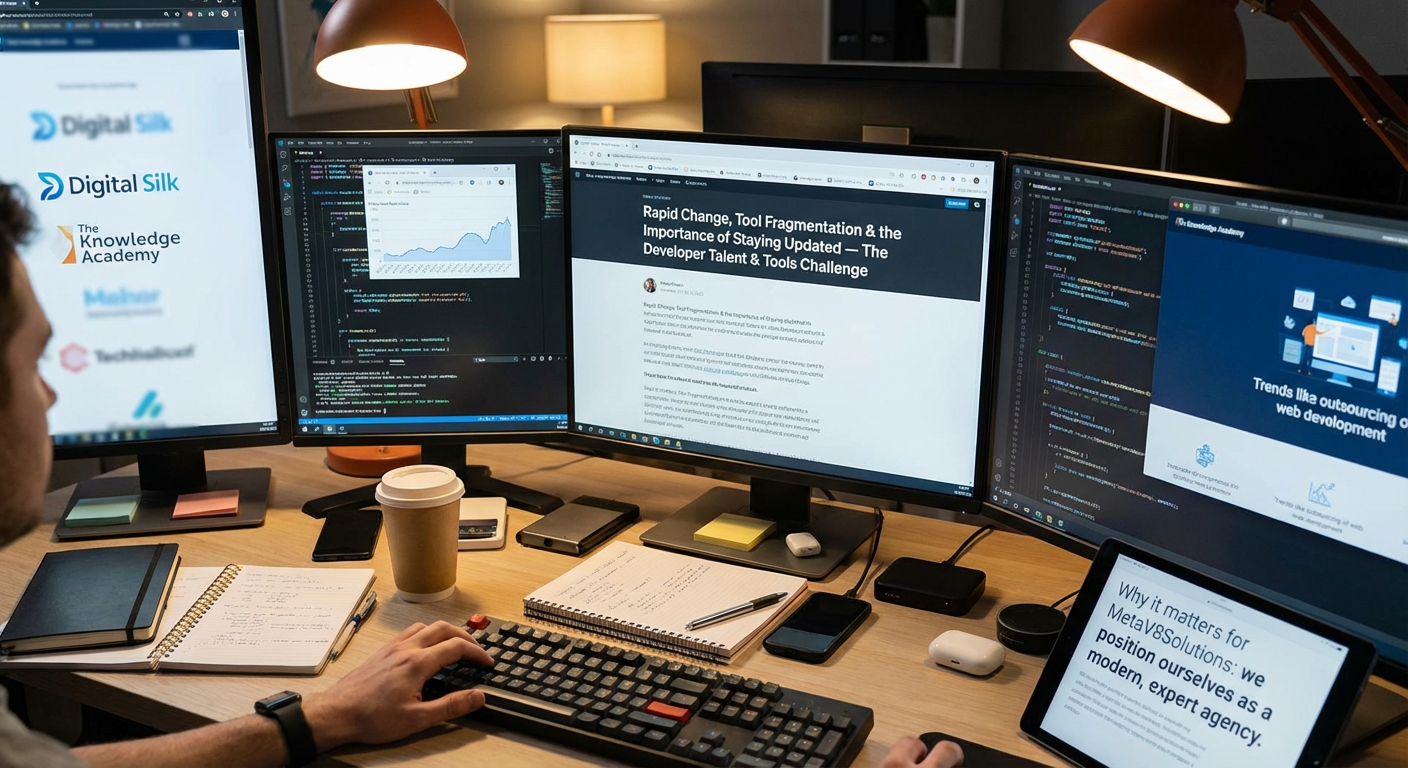
How forward-thinking agencies are turning industry chaos into competitive advantage
The web development landscape has always been dynamic, but what we’re witnessing today goes beyond typical evolution. We’re in the midst of a fundamental transformation that’s reshaping how websites are built, deployed, and maintained. For businesses seeking online presence, this creates both unprecedented opportunities and significant risks. For developers and agencies, it demands a complete rethinking of how they approach their craft.
Every year, new JavaScript frameworks emerge promising to revolutionize how we build user interfaces. Cloud platforms introduce services that didn’t exist twelve months ago. Best practices that were gospel truth last year are now considered outdated or even harmful. The tools developers used to build award-winning websites in 2020 might produce results that feel antiquated today.
This isn’t just about technology for technology’s sake. The rapid pace of change directly impacts business outcomes. Websites built with modern practices load faster, convert better, rank higher in search results, and provide superior user experiences. Those clinging to legacy approaches find themselves increasingly disadvantaged in competitive markets.
For agencies like MetaV8Solutions, this environment presents a defining choice: attempt to be everything to everyone while struggling to keep pace, or specialize deeply in modern practices and position ourselves as experts who deliver genuine value in a complex landscape. We’ve chosen the latter path, and this comprehensive exploration will explain why that matters for businesses seeking web development partners.
Understanding the Current State of Web Development
The Acceleration of Change
If you’ve been involved in web development for any length of time, you’ve noticed something peculiar happening over the past decade. The pace of change hasn’t just increased—it’s accelerated exponentially. What once took years to shift now happens in months. Frameworks rise and fall with dizzying speed. Best practices evolve continuously.
Consider the trajectory: In the early days of the web, HTML remained relatively stable for years at a time. CSS evolved slowly and predictably. JavaScript was primarily used for simple interactions and form validation. A developer could learn the core technologies once and rely on that knowledge for extended periods.
Today’s reality couldn’t be more different. The JavaScript ecosystem alone introduces thousands of new packages monthly. Major frameworks release significant updates quarterly. Browser capabilities expand continuously. Server architectures have transformed from simple request-response models to complex distributed systems involving edge computing, serverless functions, and sophisticated caching layers.
This acceleration isn’t arbitrary or driven merely by developer enthusiasm for new tools. It reflects genuine improvements in what’s possible and necessary. Modern users expect instantaneous page loads, seamless interactions, and experiences that work flawlessly across devices. Search engines reward technical excellence with better rankings. Security threats evolve constantly, requiring ongoing vigilance and updated practices.
The businesses that thrive online are those whose digital presence reflects current capabilities rather than dated approaches. And the agencies that serve them successfully are those that have built systems for continuous learning and adaptation.
The Fragmentation Problem
Alongside acceleration, we’re witnessing unprecedented fragmentation in the tools and approaches available to web developers. This isn’t inherently negative—variety often indicates a healthy, innovative ecosystem. But it creates genuine challenges for those trying to make informed decisions.
Consider the choices facing someone building a new website today. For the frontend framework, they might evaluate React, Vue, Angular, Svelte, Solid, Qwik, or numerous others. For meta-frameworks that provide additional structure, there’s Next.js, Nuxt, SvelteKit, Astro, Remix, and more. CSS approaches range from traditional stylesheets to CSS-in-JS solutions to utility-first frameworks like Tailwind. Backend options span from traditional monolithic applications to microservices to serverless architectures to edge functions.
Each choice carries implications for performance, developer experience, maintainability, hosting costs, and hiring considerations. And these decisions compound—choices made early constrain or enable later options. Selecting an inappropriate stack for a project’s specific needs can result in technical debt that haunts a project for years.
For individual developers, this fragmentation makes it virtually impossible to maintain deep expertise across the entire landscape. The days when a single person could reasonably claim mastery of all relevant web technologies are gone. Specialization has become not just advantageous but necessary.
For agencies, fragmentation demands strategic decisions about where to focus. Attempting to offer expertise in every possible technology stack stretches resources thin and typically results in mediocre execution across the board. The agencies delivering the best results are those that have chosen their technologies thoughtfully and invested deeply in genuine mastery.
Why Legacy Approaches Persist (And Why They’re Problematic)
Given the clear advantages of modern approaches, one might wonder why legacy practices persist. The answer involves several interconnected factors, and understanding them helps explain the current market dynamics.
First, there’s the simple matter of inertia. Organizations that have built processes around certain technologies don’t change easily. Developers who have invested years learning particular frameworks are reluctant to abandon that expertise. Agencies with existing codebases and maintenance contracts find it easier to continue with familiar approaches than to invest in learning new ones.
Second, the rapid pace of change creates genuine uncertainty about which new approaches will prove durable. Not every new framework becomes the next React. Not every architectural pattern achieves widespread adoption. Some organizations respond to this uncertainty by waiting—often too long—to adopt proven improvements.
Third, there’s a skills gap in the market. Modern web development practices require genuine expertise that many developers haven’t yet acquired. Some agencies continue with legacy approaches simply because their team lacks the capability to work differently, even if they recognize the superiority of newer methods.
The problem is that websites built with legacy approaches increasingly fail to meet modern expectations. Users who experience smooth, fast interactions elsewhere grow frustrated with sluggish, outdated interfaces. Search engines that reward technical excellence penalize sites with poor performance metrics. Security vulnerabilities in outdated dependencies create business risks.
For businesses, this creates an important consideration when selecting development partners. The lowest-cost option often reflects legacy practices that will result in an inferior product. The agency promising everything may lack deep expertise in anything. Finding partners with genuine, current expertise requires looking beyond surface-level claims.
The Framework Wars: Understanding Today’s JavaScript Landscape
React’s Continued Dominance and Evolution
React remains the dominant force in frontend development, but it would be a mistake to view it as static or settled technology. The React of today differs substantially from the React of even two years ago, and understanding these changes matters for anyone building or maintaining React applications.
The introduction of React Server Components represents perhaps the most significant shift in React’s history. This architecture fundamentally changes how React applications can be structured, enabling server-side rendering patterns that weren’t previously possible while maintaining React’s component model. For developers, this means learning new mental models. For applications, it means potential improvements in performance and user experience.
Hooks, introduced several years ago, have now fully matured as the standard approach to React development. The older class-based component patterns, while still supported, are increasingly viewed as legacy code. Agencies and developers maintaining older React applications face ongoing decisions about modernization versus maintenance.
The surrounding ecosystem has evolved equally dramatically. State management, once dominated by Redux, now involves a diverse landscape including Zustand, Jotai, Recoil, and React’s own built-in capabilities. Styling approaches have shifted from CSS Modules and styled-components toward utility-first frameworks. Data fetching patterns have evolved from simple useEffect calls to sophisticated libraries like React Query and SWR.
For businesses, this evolution means that a “React website” can mean very different things depending on when it was built and who built it. Modern React applications leverage the latest patterns and capabilities. Older React applications may technically function but miss out on significant improvements in performance, maintainability, and developer experience.
The Rise of Next.js and the Meta-Framework Revolution
Above the framework level, meta-frameworks have become essential parts of the modern web development stack. Next.js, built on React, exemplifies this trend and has achieved remarkable adoption.
Next.js provides structure and capabilities that raw React lacks: routing, server-side rendering, static generation, API routes, image optimization, and more. It embodies opinions about how modern web applications should be built, reducing decision fatigue for development teams while enabling sophisticated capabilities.
The recent introduction of the App Router in Next.js 13 and 14 represents another significant evolution. This new routing paradigm, built around React Server Components, changes how developers structure applications. It offers potential improvements in performance and capability but requires learning new patterns and may necessitate substantial refactoring of existing applications.
Beyond Next.js, the meta-framework space has become increasingly competitive and specialized. Remix, now part of Shopify, offers different opinions about data loading and mutations. Astro has gained significant traction with its “islands” architecture, particularly for content-focused sites. SvelteKit and Nuxt serve the Svelte and Vue communities respectively, providing similar capabilities for those ecosystems.
For agencies serving clients, understanding these options and their trade-offs is essential. Different projects have different needs, and the optimal framework choice varies accordingly. An e-commerce site with complex interactivity has different requirements than a content marketing site that prioritizes search visibility. A web application with real-time features needs different architecture than a relatively static corporate website.
Emerging Alternatives and Their Promise
While React and its ecosystem dominate, alternative approaches continue to emerge and mature, some offering compelling advantages for specific use cases.
Svelte has gained substantial traction with its compile-time approach that eliminates the need for a virtual DOM. The result is smaller bundle sizes and often better performance, particularly for applications where bundle size is a concern. SvelteKit provides the meta-framework capabilities that make building complete applications practical.
Solid.js offers a reactive programming model that some developers find more intuitive than React’s while maintaining excellent performance characteristics. Its growing ecosystem and passionate community suggest continued growth.
Qwik represents one of the more radical rethinkings of frontend frameworks, with its “resumability” model that eliminates the hydration step traditionally required for server-rendered applications. This can result in dramatically faster time-to-interactive metrics, particularly for content-heavy sites.
Astro has achieved particular success in the content-focused site space. Its approach of shipping zero JavaScript by default, combined with the ability to include interactive “islands” when needed, produces extremely fast sites while allowing modern development practices.
For agencies, awareness of these alternatives is important even if they’re not the primary tools in use. Client needs sometimes align particularly well with specific frameworks. Understanding the landscape enables informed recommendations and ensures clients receive solutions optimized for their particular requirements.
The Backend Revolution: Beyond Traditional Servers
The Serverless Transformation
Perhaps no shift in web development has been more significant than the rise of serverless computing. This architectural approach has fundamentally changed how many applications are built and deployed, with implications for cost, scalability, and development practices.
Traditional web application deployment involved provisioning servers—whether physical machines, virtual private servers, or cloud instances—and running application code continuously on those servers. This model required capacity planning, server maintenance, and typically resulted in paying for resources whether they were actively used or sitting idle.
Serverless computing inverts this model. Functions are deployed to cloud platforms and execute only when triggered by requests. Payment is based on actual usage rather than provisioned capacity. Scaling happens automatically based on demand. Many operational concerns are offloaded to the platform provider.
This shift has profound implications for web development. API endpoints that once required always-running servers can now be implemented as serverless functions. Background processing tasks can execute on-demand. The economics of building and operating web applications have fundamentally changed.
Major cloud providers—AWS Lambda, Azure Functions, Google Cloud Functions—have made serverless capabilities broadly accessible. Platforms like Vercel and Netlify have built developer-friendly abstractions on top of these capabilities, making serverless deployment approachable for frontend developers who might not consider themselves infrastructure specialists.
For businesses, serverless architecture often means lower operating costs, better scalability, and reduced operational burden. For agencies, it means adopting new patterns and approaches that differ significantly from traditional server management.
Edge Computing and Its Implications
The latest evolution in web infrastructure involves edge computing—the practice of running application code geographically close to users rather than in centralized data centers. This approach dramatically reduces latency and enables new patterns that weren’t previously practical.
When a user in Tokyo accesses a website hosted in Virginia, network latency adds unavoidable delay to every request. Edge computing addresses this by running application logic at points of presence distributed globally. User requests are handled by nearby infrastructure, reducing round-trip time substantially.
Platforms like Cloudflare Workers, Vercel Edge Functions, and similar offerings have made edge computing increasingly accessible. Modern frameworks have built in edge capabilities, allowing developers to specify which parts of their applications should run at the edge versus in traditional server environments.
The implications extend beyond raw performance. Edge computing enables personalization without the latency penalty traditionally associated with server-rendered personalized content. Geographic restrictions can be enforced at the edge. Certain types of bot protection and security measures work more effectively when applied close to the user.
For agencies building modern websites, understanding edge computing and when to apply it has become an important capability. Not every application needs edge computing, but those that benefit from it see meaningful improvements in user experience and performance metrics.
The API Economy and Headless Architecture
Modern web development increasingly involves integrating multiple services rather than building everything from scratch. This “API economy” has transformed how web applications are architected and has given rise to headless approaches that separate presentation from content management and commerce logic.
Traditional content management systems like WordPress combine content storage, content management interfaces, and frontend presentation in a single, tightly coupled system. Headless CMS platforms like Contentful, Sanity, Strapi, and others separate content management from presentation. Content is stored and managed in the CMS, then delivered via API to frontend applications that can be built with any technology.
This separation provides significant flexibility. The same content can power a website, a mobile application, and digital displays. Frontend developers can work in modern frameworks without being constrained by the CMS’s technical choices. Content editors get purpose-built interfaces optimized for their needs.
Similarly, headless commerce platforms like Shopify’s Hydrogen, BigCommerce, and Commercetools separate commerce logic from presentation. This enables custom frontend experiences while leveraging proven commerce infrastructure for inventory, payments, and fulfillment.
For businesses, headless approaches often mean better user experiences, more flexibility for future changes, and cleaner separation of concerns between marketing teams managing content and development teams building experiences. For agencies, it requires expertise in integrating multiple systems and building custom frontends that leverage these services effectively.
The Outsourcing Landscape: Global Trends and Implications
Understanding the Global Development Market
Web development has long been a globally distributed activity, and this trend continues to intensify. Businesses seeking development services operate in a truly global marketplace, with implications for pricing, quality, and how agencies compete.
Outsourcing web development remains prevalent across businesses of all sizes. Cost differentials between geographic regions create strong incentives to seek development resources in lower-cost markets. The maturation of remote collaboration tools during the pandemic has further normalized distributed development work.
Major outsourcing destinations—including India, Eastern Europe, Southeast Asia, and Latin America—have developed substantial web development sectors serving clients worldwide. These markets offer significant cost advantages and include genuinely skilled developers capable of quality work.
However, the outsourcing landscape involves important nuances that businesses should understand. Price variation between geographic regions often correlates with differences in expertise, communication capabilities, and management overhead required. The lowest-cost option is rarely the best value when true total cost is considered.
Time zone differences create coordination challenges that can slow project progress and complicate communication. Cultural differences in work styles and communication norms require adjustment from both parties. Quality variation within any given market means that geographic stereotypes are unreliable guides.
For businesses evaluating development partners, understanding these dynamics helps in making informed decisions. For agencies operating in higher-cost markets, it underscores the importance of delivering value that justifies price differences.
The Quality Spectrum in Global Development
The global development market includes exceptional talent and mediocre performers across every geography. Rather than making decisions based on location, businesses benefit from understanding what distinguishes quality development work regardless of where it originates.
Technical excellence manifests in specific, observable ways. Well-structured, maintainable code follows established patterns and principles. Performance is considered from the start rather than addressed as an afterthought. Security best practices are built in rather than bolted on. Accessibility is treated as a requirement rather than an optional enhancement.
Process maturity shows in how projects are managed. Clear communication establishes expectations and surfaces issues early. Documented processes ensure consistency across engagements. Version control, testing, and deployment practices reflect professional standards.
Business understanding differentiates development work that achieves objectives from technically correct work that misses the point. The best development partners understand what the client is trying to accomplish, not just what they’ve asked for. They contribute strategic thinking alongside technical execution.
For agencies like MetaV8Solutions, competing effectively means consistently delivering on these dimensions rather than competing primarily on price. Clients who understand the value of genuine expertise will pay appropriately for it. Those who see development as a commodity purchase will continue finding vendors willing to compete on price alone.
Finding the Right Balance
The global development market isn’t a binary choice between local agencies and offshore outsourcing. Most sophisticated buyers have learned to navigate nuances and find arrangements that balance cost, quality, communication, and control.
Some organizations maintain core development capabilities in-house or with closely aligned partners while using global resources for specific, well-defined tasks. This hybrid approach captures some cost benefits while maintaining strategic control and quality oversight.
Others prioritize full-service relationships with agencies that take end-to-end responsibility for outcomes, accepting higher costs in exchange for reduced management burden. This approach makes particular sense when development is not a core competency of the organization.
Still others build deep relationships with specific offshore teams or partners, investing in the relationship over time to address communication and quality challenges. This approach requires patience and investment but can yield excellent results.
For MetaV8Solutions, our positioning reflects a specific choice within this landscape. We position ourselves as a modern, expert agency—not attempting to compete on price with the lowest-cost global providers, but instead delivering value that justifies our approach through genuine expertise in current technologies and practices.
The Skills Gap: Challenges and Opportunities
The Widening Expertise Divide
The rapid pace of technological change has created a significant skills gap in the web development industry. This gap manifests differently for individual developers, agencies, and the businesses they serve.
For individual developers, maintaining current skills requires continuous learning. Technologies that were cutting-edge when they entered the field may be deprecated or obsolete today. Career success increasingly depends on the ability to learn continuously rather than relying on static expertise.
Many developers, particularly those with established careers, find this continuous learning requirement challenging. Competing demands on time—client work, family responsibilities, personal interests—leave limited bandwidth for ongoing education. Some respond by specializing narrowly, developing deep expertise in specific technologies. Others maintain broader but necessarily shallower knowledge across more areas.
For agencies, the skills gap creates hiring and retention challenges. Developers with current, in-demand skills have options and command premium compensation. Agencies unable or unwilling to pay competitive rates struggle to attract top talent. Those who succeed in hiring must also invest in ongoing training to keep skills current.
The result is a widening divide between agencies operating at the cutting edge and those relying on legacy skills and approaches. This divide is often invisible to clients who lack the technical expertise to evaluate partner capabilities. The agency using outdated approaches may present well and quote lower prices while delivering inferior results.
The Continuous Learning Imperative
Successful navigation of today’s development landscape requires commitment to continuous learning at both individual and organizational levels. This isn’t optional or aspirational—it’s a basic requirement for relevance.
At the individual level, developers must build learning into their regular practice. This includes following industry developments, experimenting with new technologies, contributing to and learning from open source projects, and engaging with developer communities. It also requires deliberate investment of time and energy in structured learning through courses, workshops, and deep study.
At the organizational level, agencies must create environments that support and encourage continuous learning. This includes providing time and resources for professional development, creating opportunities to apply new skills on actual projects, and building culture that values growth and adaptation. It also requires strategic decisions about which technologies to invest in deeply versus which to monitor from a distance.
For MetaV8Solutions, continuous learning is central to our identity and operations. We’ve built systems and practices specifically designed to keep our team current with modern web development. This investment is substantial, but it’s what enables us to deliver genuinely modern solutions to our clients.
Implications for Hiring and Team Building
The skills gap has significant implications for how development teams are built and managed, whether in-house or through agency partnerships.
Organizations building in-house development capabilities face challenging decisions. Hiring developers with current, cutting-edge skills means competing for scarce talent against well-funded tech companies. Hiring less expensive developers with dated skills may seem economical but often proves costly when projects require capabilities beyond their expertise.
Training existing developers to acquire new skills is possible but requires substantial investment and patience. Not all developers adapt equally well to new paradigms, and the training investment is lost if developers leave for other opportunities.
For organizations without in-house development capabilities, these dynamics underscore the importance of careful agency selection. The agency’s actual technical capabilities—not just their marketing claims—determine what they can deliver. Evaluating those capabilities requires either technical expertise or trust in the agency’s representations.
The agencies best positioned to serve clients have solved their own talent challenges. They’ve attracted and retained developers with current skills. They’ve built practices for continuous improvement. They can demonstrate genuine expertise rather than merely claiming it.
Technical Excellence in Modern Web Development
Performance as a Core Requirement
Performance has evolved from a nice-to-have to a core requirement in modern web development. Users expect instantaneous response. Search engines reward fast sites with better rankings. Business metrics—conversion rates, engagement, revenue—correlate strongly with performance.
Modern performance optimization extends far beyond the simple advice of earlier eras. Minimizing HTTP requests and compressing images remain relevant but represent only a fraction of what’s required for truly fast sites.
Today’s performance optimization involves sophisticated strategies across multiple dimensions. Code splitting ensures users download only the JavaScript they actually need. Server-side rendering and static generation reduce time-to-first-paint. Image optimization includes modern formats, responsive sizing, and lazy loading. Font loading strategies prevent layout shift and reduce perceived loading time.
Advanced techniques go further still. Prefetching and preloading anticipate user navigation and prepare resources in advance. Service workers enable sophisticated caching strategies. Edge computing reduces latency for dynamic content. Speculative rendering can begin processing before user actions complete.
Measuring and monitoring performance requires understanding modern metrics—Core Web Vitals and their components, time-to-interactive, speed index, and others. It requires tooling to capture these metrics in production across diverse user conditions, not just in controlled testing environments.
For agencies delivering modern websites, performance expertise is non-negotiable. Clients may not fully understand the technical details, but they understand when their site feels fast or slow. Search rankings provide objective feedback on performance relative to competitors. Business results ultimately reveal whether performance optimization was successful.
Security in an Increasingly Hostile Environment
The web security landscape grows more challenging each year. Attacks are more sophisticated, automated at scale, and target both common vulnerabilities and obscure weaknesses. Securing modern web applications requires ongoing vigilance and current practices.
Modern security considerations span multiple layers. Dependencies—the third-party packages modern applications rely upon—represent a significant attack surface. Supply chain attacks, where legitimate packages are compromised, have become increasingly common. Managing dependencies securely requires careful vetting, prompt updates, and monitoring for known vulnerabilities.
Authentication and authorization, fundamental to most applications, involve increasingly sophisticated considerations. Password-based authentication is supplemented or replaced by multi-factor authentication, passwordless approaches, and integration with identity providers. Authorization logic must be carefully implemented to prevent privilege escalation and unauthorized access.
Data protection involves both technical measures and compliance considerations. Encryption protects data in transit and at rest. Privacy regulations like GDPR and CCPA create legal obligations around data handling. Security headers, content security policies, and other browser features help prevent common attack patterns.
Infrastructure security includes protecting the environments where applications run. Cloud platforms offer powerful security features, but they require correct configuration. Misconfigured cloud resources are a common source of security incidents. Serverless and edge architectures introduce different security considerations than traditional servers.
For agencies building modern websites, security must be built in from the start rather than addressed as an afterthought. This requires current knowledge of threats and countermeasures, which evolve continuously.
Accessibility as a Fundamental Requirement
Accessibility—ensuring websites are usable by people with disabilities—has become both a legal requirement and a competitive advantage. Modern web development treats accessibility as a fundamental requirement rather than an optional enhancement.
Legal landscapes vary by jurisdiction, but the trend toward mandating accessibility is clear. The Americans with Disabilities Act has been interpreted to apply to websites in many contexts. The European Accessibility Act creates explicit requirements for digital services. Organizations that ignore accessibility face increasing legal risk.
Beyond compliance, accessibility improvements benefit all users. The techniques that make sites usable with screen readers often improve usability for everyone. Mobile users, users with situational impairments, and users in challenging environments all benefit from accessible design.
Implementing accessibility requires understanding relevant standards—primarily WCAG 2.1 and emerging WCAG 3.0 guidelines. It requires testing with actual assistive technologies, not just automated scanning tools. It requires considering accessibility at every stage of design and development, not just attempting to retrofit it later.
Modern development frameworks and tools have improved support for accessibility, but they don’t guarantee it automatically. Accessible implementation requires conscious effort and expertise. The agencies delivering genuinely accessible websites have invested in developing that expertise.
Modern Development Practices and Workflows
Beyond specific technologies, modern web development involves sophisticated practices and workflows that improve quality, reliability, and efficiency.
Version control with Git is now universal, but effective Git workflows vary significantly. Teams that have mastered branching strategies, code review processes, and merge practices work more effectively than those with chaotic repositories.
Continuous integration and continuous deployment (CI/CD) automate testing and deployment, catching issues early and enabling rapid, reliable releases. Modern deployment platforms have made CI/CD accessible to teams of all sizes.
Automated testing—unit tests, integration tests, end-to-end tests—provides confidence that changes don’t introduce regressions. The appropriate testing strategy varies by project, but some level of automated testing is standard practice.
Code quality tools—linters, formatters, type checkers—enforce consistency and catch certain classes of issues automatically. TypeScript adoption continues growing, bringing static type checking to JavaScript development.
Documentation practices ensure that code remains maintainable over time. This includes inline documentation, architecture documentation, and operational runbooks for production systems.
For agencies delivering modern websites, these practices distinguish professional work from amateur efforts. They reduce defects, enable confident changes, and improve long-term maintainability.
Strategic Positioning in a Complex Market
The Specialist Advantage
In a market characterized by rapid change and extensive fragmentation, specialization provides significant advantages over generalist approaches.
Specialists can invest deeply in their chosen areas, developing genuine expertise rather than superficial familiarity. This depth enables them to make better technical decisions, solve problems more efficiently, and deliver higher-quality results.
Specialists can follow developments in their focus areas closely, maintaining currency with the latest changes. Generalists, spread across many areas, inevitably lag behind in all of them.
Specialists can build reusable components, processes, and knowledge that compound over time within their specialty. This accumulated capital makes them increasingly efficient and effective.
For clients, working with specialists means accessing genuine expertise rather than hoping a generalist can figure things out. It means getting the benefit of lessons learned across many similar projects. It means confidence that the partner truly understands the problem space.
The risk of specialization is missing opportunities outside the focus area. However, for agencies that choose their specialty wisely, the depth advantages outweigh the breadth limitations.
Communicating Modern Expertise
Agencies with genuine modern expertise must communicate that expertise effectively to potential clients who may lack the technical background to evaluate claims directly.
Case studies and portfolio work provide concrete evidence of capabilities. They’re most effective when they include specific technical details rather than just visual presentation. Clients may not understand all the technical content, but its presence signals genuine depth.
Content marketing—blog posts, tutorials, conference talks, open source contributions—demonstrates expertise in action. Agencies that can teach concepts credibly establish themselves as genuine authorities.
Credentials and certifications provide third-party validation, though their value varies. Platform-specific certifications from Vercel, AWS, Google, and others signal investment in particular technologies.
Clear articulation of technical approach helps clients understand what they’re getting. What frameworks and tools does the agency use? What architectural patterns do they apply? What processes ensure quality? Agencies that can articulate these clearly demonstrate thoughtful practice.
For MetaV8Solutions, communicating our modern expertise is an ongoing effort. We invest in creating content that demonstrates our capabilities. We maintain current certifications in our focus technologies. We’re transparent about our technical approaches and why we’ve made specific choices.
Pricing Strategy and Value Articulation
Agencies delivering modern, high-quality web development must price appropriately to sustain their practices. This often means higher prices than commoditized alternatives, which requires effective value articulation.
The lowest price in the market typically reflects either inferior practices, unsustainable economics, or misunderstanding of project requirements. Clients who select purely on price often regret that decision when projects fail or require expensive remediation.
Value articulation connects the agency’s specific practices to outcomes clients care about. Modern architecture produces faster sites—and faster sites convert better and rank higher. Security expertise reduces breach risk—and breaches cause substantial business damage. Maintainable code enables future changes—and businesses inevitably need to evolve their websites over time.
The total cost of ownership perspective often favors quality over cheapness. A website that costs more upfront but performs better, requires less maintenance, and lasts longer may be far less expensive in total than a cheaper alternative that needs constant fixes and eventual replacement.
For sophisticated clients, quality development is an investment with positive returns rather than a cost to be minimized. Agencies serving these clients need not compete on price but rather on demonstrating superior value.
The MetaV8Solutions Approach
Our Technical Philosophy
At MetaV8Solutions, we’ve built our practice around a clear technical philosophy that guides our decisions and shapes the solutions we deliver.
We believe in using the right tools for each specific problem rather than forcing everything into a single familiar framework. This requires maintaining broad awareness of available options while developing deep expertise in our primary technologies. When a project’s needs align well with our specialties, we can deliver exceptional results. When different tools would serve better, we say so honestly.
We believe in building for the future, not just the present. Websites are not disposable artifacts but long-lived assets that must evolve over time. Architecture decisions made today constrain options for years to come. We prioritize maintainability, flexibility, and clean separation of concerns.
We believe in measuring outcomes, not just completing tasks. Beautiful code that doesn’t achieve business objectives has failed. We stay focused on what the website needs to accomplish and use that as our primary measure of success.
We believe in transparency about capabilities and limitations. We’re clear about what we do well and honest about what falls outside our expertise. Clients deserve accurate information to make informed decisions.
Our Technical Stack and Capabilities
Our primary technical focus centers on the modern JavaScript ecosystem, with particular depth in React and Next.js. This choice reflects the maturity, capabilities, and market position of these technologies. They enable us to build virtually any type of web application or website, from simple marketing sites to complex web applications.
We’ve developed particular expertise in several areas. Performance optimization is central to our practice—we understand modern performance metrics deeply and know how to achieve excellent results. We have strong capabilities in headless CMS integration, having worked extensively with Contentful, Sanity, and similar platforms. Our e-commerce experience spans headless Shopify implementations and custom commerce solutions.
Our infrastructure expertise focuses on modern deployment platforms and practices. We work extensively with Vercel and similar platforms that enable sophisticated deployment patterns without heavy operational burden. We understand serverless and edge computing and apply them where they provide genuine benefit.
We maintain current with emerging technologies and evaluate them for potential adoption. Not everything new is better, but when genuine improvements emerge, we work to incorporate them into our practice.
Our Process and Practices
Beyond technical capabilities, our process and practices enable consistent quality delivery.
Every engagement begins with discovery focused on understanding the client’s actual objectives, not just their stated requirements. We ask why repeatedly until we truly understand what success looks like. This understanding shapes every subsequent decision.
Design and development proceed iteratively, with regular check-ins and opportunities for client feedback. We believe in showing work frequently and adjusting based on response rather than disappearing for months and revealing completed work.
Quality assurance is built into our process, not tacked on at the end. Code review catches issues early. Automated testing provides ongoing verification. Performance and accessibility testing happens throughout development.
Documentation and knowledge transfer ensure that clients understand what they’re receiving. We don’t hold clients hostage through obscurity. They own their code and can work with any qualified developer if they choose to move on.
Post-launch, we provide ongoing support and maintenance services. Websites require ongoing attention—security updates, content changes, feature enhancements. We structure relationships for long-term success, not just project completion.
The Business Case for Modern Development
Performance and Business Outcomes
The connection between website performance and business outcomes is well-established and increasingly quantified. For businesses evaluating development partners, understanding this connection helps contextualize the value of modern expertise.
Page load time directly impacts conversion rates. Studies consistently show that slower pages convert less well, with the effect compounding as delays increase. A one-second improvement in load time can translate to meaningful revenue increases for commerce sites.
Search rankings increasingly incorporate performance signals. Google’s Core Web Vitals are explicit ranking factors. Sites that perform poorly face penalties in search visibility, reducing organic traffic over time.
User experience and brand perception connect to performance. Users who experience fast, smooth interactions form positive impressions. Those frustrated by slow, janky interfaces associate that frustration with the brand.
Mobile users, who represent the majority of web traffic for many sites, are particularly sensitive to performance issues. Network conditions and device capabilities make performance optimization even more important for reaching this audience effectively.
For businesses, this means that performance isn’t a technical nicety—it’s a business imperative. Agencies that can deliver genuinely fast sites provide measurable business value.
Long-term Cost Considerations
The true cost of web development extends far beyond the initial project price. Considering long-term costs often favors quality development over cheaper alternatives.
Maintainability determines how expensive future changes will be. Clean, well-structured code can be modified efficiently. Tangled, undocumented code requires extensive effort to understand before any change can be made. Over years of ongoing development, maintainability differences compound dramatically.
Technical debt accumulates when shortcuts are taken. Debt must eventually be paid—either through increasingly painful ongoing maintenance or through expensive rebuilding. Quality development minimizes debt accumulation.
Security vulnerabilities in poorly maintained sites can cause substantial business damage. Data breaches, defacement, and service disruption carry real costs. Proper security practices reduce these risks.
Scalability limitations in poorly architected sites may require expensive rework as traffic grows. Sites built with scalability in mind handle growth gracefully.
For businesses evaluating development options, the initial price is only one factor. The total cost of ownership, including ongoing maintenance and eventual replacement, often tells a different story.
Competitive Positioning Through Digital Excellence
For many businesses, their website is their most important competitive asset. The quality of that website directly impacts their competitive position.
In crowded markets, user experience differentiates. When products or services are similar, the ease and pleasure of doing business tips decisions. A superior website experience provides ongoing competitive advantage.
In digital-first markets, the website essentially is the product. E-commerce businesses, SaaS companies, and online service providers succeed or fail based largely on their digital experiences.
Even for businesses where the website is not the primary product, digital presence shapes perception. B2B buyers research vendors online before engaging. Professional services firms are judged partly by their website quality. The website signals organizational competence and modernity.
For businesses recognizing these dynamics, investing in genuinely excellent web development makes strategic sense. Finding partners capable of delivering that excellence is worth the effort.
Looking Forward: Emerging Trends and Preparations
The AI Integration Wave
Artificial intelligence and machine learning are beginning to impact web development in various ways, and this trend will only accelerate.
AI-powered development tools are becoming increasingly capable. Code completion suggestions, automated code generation, and AI-assisted debugging are already changing developer workflows. These tools enhance productivity for skilled developers but don’t eliminate the need for expertise—understanding what to build and evaluating what AI produces remain human responsibilities.
AI features within web applications are becoming more common. Chatbots, personalization engines, content generation, and recommendation systems increasingly incorporate AI capabilities. Developing and integrating these features requires new skills and considerations.
AI impacts on design include generative tools that can produce visual assets, layout suggestions, and even code from descriptions. These capabilities are evolving rapidly, and their implications for development workflows are still emerging.
For agencies, AI presents both opportunity and challenge. Those who learn to leverage AI tools effectively will become more productive. Those who understand how to integrate AI capabilities into client solutions can offer enhanced value. But AI also potentially commoditizes certain tasks, putting pressure on services that don’t evolve.
The Continued Evolution of JavaScript
The JavaScript ecosystem shows no signs of slowing its evolution. Several trends seem likely to shape its near-term future.
Server-first approaches are gaining momentum. The traditional single-page application model, where JavaScript runs primarily in the browser, is being supplemented by approaches that do more work on the server. React Server Components, island architectures, and similar patterns reflect this shift.
Build tool evolution continues with newer entrants like Vite, Turbopack, and others challenging established tools. Faster builds improve developer experience and deployment speed.
TypeScript adoption continues expanding, with many new projects now starting in TypeScript by default. The type safety and tooling benefits have proven compelling.
Edge computing integration is becoming more seamless, with frameworks providing straightforward ways to run code at the edge without extensive infrastructure expertise.
For agencies, staying current with these evolutions requires ongoing attention and investment. The approaches that work best today may give way to improved alternatives within months.
Preparing for Uncertainty
Given the pace of change, detailed predictions about specific technologies quickly become obsolete. More valuable than predictions is preparing for uncertainty.
Building learning capabilities ensures the ability to adapt to whatever changes come. Teams that have mastered learning new technologies can navigate whatever the future brings.
Focusing on fundamentals provides stable foundations even as surface technologies change. Understanding HTTP, browser behavior, database concepts, and software architecture principles remains valuable regardless of framework choices.
Maintaining flexibility in technical choices allows adaptation as circumstances change. Avoiding lock-in to specific vendors or technologies preserves options.
Cultivating industry awareness ensures that changes don’t come as surprises. Following thought leaders, engaging with communities, and tracking developments provides early warning of significant shifts.
For MetaV8Solutions, we’ve built our practice to thrive amid uncertainty. We don’t claim to predict the future, but we’re confident in our ability to adapt and continue delivering value as the landscape evolves.
Conclusion: The Path Forward
The web development landscape presents genuine challenges. Rapid change makes yesterday’s expertise obsolete. Tool fragmentation creates overwhelming choice. The global market introduces both competition and quality uncertainty. Skills gaps divide those with current capabilities from those relying on dated approaches.
But within these challenges lie opportunities. For businesses seeking development partners, the agencies that have navigated these challenges successfully can deliver exceptional value. For agencies that have made the investments to stay current, the ability to deliver genuinely modern solutions commands premium positioning.
MetaV8Solutions has made a deliberate choice in this landscape. We’re not trying to be everything to everyone. We’re not competing on price with the lowest-cost global options. We’re not clinging to legacy approaches because they’re familiar.
Instead, we’ve positioned ourselves as a modern, expert agency specializing in current technologies and practices. We invest continuously in staying current. We build deep expertise rather than shallow breadth. We deliver cutting-edge websites for clients who need modern-quality web solutions.
For businesses evaluating development partners, we encourage looking beyond surface-level claims. Examine actual technical capabilities. Evaluate whether partners have invested in staying current. Consider not just initial costs but long-term value. The right development partner can provide genuine competitive advantage through digital excellence.
The web will continue evolving. New frameworks will emerge. Best practices will shift. The only constant is change. In that environment, the most valuable attribute is the ability to adapt while maintaining quality and focus.
That’s what we’ve built at MetaV8Solutions. That’s what we deliver to our clients. And that’s what we believe distinguishes truly valuable development partnerships in today’s complex landscape.
Ready to discuss how modern web development expertise can serve your business objectives? Contact MetaV8Solutions to explore how we can help you build competitive advantage through digital excellence.
 🚀 Crafting websites that perform, impress & convert. From sleek designs to full digital strategies, we help brands grow online. 💻 Web Design | SEO | Branding | Hosting | Maintenance. Your 24/7 digital marketing engine starts here.
0 Comments