
A deep dive into why your Instagram posts and Facebook ads aren’t cutting it—and what the smartest businesses are doing instead
Let me start with a confession.
For years, I was one of those people who genuinely believed that if you just “showed up” on social media consistently enough, the clients would come. Post three times a day. Use the right hashtags. Engage with your audience. Build a community. The formula seemed so simple, so democratic. Anyone with a smartphone and a Wi-Fi connection could build a business empire from their living room couch.
And for a while, that was actually true.
But here’s the thing nobody talks about at those digital marketing conferences anymore: the game has fundamentally changed. Not in some gradual, barely-noticeable way—but in a seismic shift that’s left countless businesses wondering why their tried-and-true strategies suddenly feel like throwing money into a black hole.
If you’re reading this in 2025 and still treating social media as your primary (or worse, your only) marketing channel, we need to have an honest conversation. Because the data doesn’t lie, and the trends we’re seeing heading into 2026 paint a picture that should make any business owner sit up and pay attention.
This isn’t about abandoning social media. Far from it. Social platforms still have their place in a comprehensive marketing ecosystem. But the era of social media as the be-all-end-all of digital marketing? That ship hasn’t just sailed—it’s halfway across the ocean and not coming back.
Let’s unpack why.
The Great Social Media Reckoning of 2025
Something interesting happened in the marketing world over the past eighteen months. It wasn’t announced in press releases or trending on Twitter (or X, as we’re still begrudgingly calling it). It happened quietly, in boardrooms and analytics dashboards, in the uncomfortable silences of quarterly reviews where the numbers just didn’t add up anymore.
Business after business started asking the same question: “Why are we spending more on social media than ever before, but seeing diminishing returns?”
The answers, as it turns out, are numerous and interconnected.
Organic reach has essentially flatlined. Remember when posting on Facebook could actually reach a significant portion of your followers? Those days feel almost quaint now. As of early 2025, organic reach on most major platforms hovers somewhere between 1-5% for business pages. That means if you’ve painstakingly built a following of 10,000 people, somewhere between 100 and 500 of them might actually see your carefully crafted content. Maybe.
And that’s before we even factor in whether they’re paying attention, whether they’re in a buying mindset, or whether your post doesn’t just become another blur in their infinite scroll.
Ad costs have skyrocketed. The cost-per-click on Facebook and Instagram has increased by roughly 30% year-over-year since 2023. LinkedIn? Even more dramatic. The platforms know they’ve got businesses hooked, and they’re squeezing every dollar they can. Small and medium-sized businesses that used to be able to compete with modest ad budgets are finding themselves priced out of meaningful visibility.
Algorithm changes have become unpredictable and aggressive. Every few months brings a new algorithmic shift that can tank engagement overnight. Businesses that built their entire customer acquisition strategy around mastering one platform’s algorithm have learned a painful lesson about building on rented land.
User behavior has fundamentally shifted. People are tired. Fatigued. Overwhelmed by the sheer volume of content vying for their attention. The average person scrolls through 300 feet of content per day—roughly the height of the Statue of Liberty. In that context, your brand’s social posts are competing with friends’ vacation photos, breaking news, memes, and an endless stream of entertainment designed by some of the world’s smartest engineers to be maximally addictive.
Good luck standing out.
The Trust Deficit: Why Social Media Credibility Has Eroded
Here’s something that doesn’t get discussed enough: consumers in 2025 are fundamentally more skeptical of social media content than they were even three years ago.
Multiple factors have contributed to this shift.
The influencer bubble has burst—at least in its original form. Too many sponsored posts that felt inauthentic. Too many “beloved products” that turned out to be whatever paid the most. Audiences have developed finely-tuned BS detectors, and they’re using them. According to recent consumer surveys, trust in influencer recommendations has dropped by nearly 40% since 2022.
The AI content explosion has made everything feel less human. When people can’t tell if they’re reading something written by a person or generated by a machine in 0.3 seconds, something intangible but important gets lost. There’s a growing hunger for authenticity that mass-produced social content simply can’t satisfy.
And let’s talk about the platforms themselves. Between data privacy scandals, content moderation controversies, and the general sense that these companies don’t have users’ best interests at heart, platform trust has taken a beating. That skepticism bleeds into how people perceive the businesses that exist on those platforms.
When your primary presence is on a platform people inherently distrust, some of that distrust attaches to your brand. Fair or not, that’s the reality.
The Fragmentation Problem: Too Many Platforms, Too Little Time
Cast your mind back to 2015. For most businesses, a solid social media strategy meant maintaining a presence on maybe three platforms: Facebook, Twitter, and perhaps Instagram if you had visual products. LinkedIn for B2B. That was it.
Today? The landscape is absurdly fragmented.
You’ve got the legacy platforms still demanding attention. But you’ve also got TikTok (still dominant despite the regulatory uncertainty), Threads (Meta’s Twitter alternative that’s found its footing), YouTube Shorts, BeReal (which pivoted to brand-friendly features), and a rotating cast of emerging platforms that promise to be “the next big thing.”
And that’s just in the Western market. If you’re doing any kind of international business, you’re looking at WeChat, Douyin, Line, Telegram channels, and region-specific platforms that each require their own strategies.
For a large enterprise with a dedicated social media team, this fragmentation is challenging but manageable. For the average small or medium-sized business? It’s a nightmare.
The conventional wisdom used to be “go where your audience is.” But your audience is now everywhere, spread across a dozen platforms, each with different content formats, different algorithms, different cultural norms. Creating truly native content for even five platforms is essentially five different marketing jobs.
Most businesses end up doing what’s unsustainable: spreading themselves too thin, creating mediocre content for multiple platforms rather than excellent content for one, and wondering why none of it seems to gain traction.
What the Data Tells Us About 2025
Let’s step back from the theoretical and look at what’s actually happening in the market right now.
Customer acquisition costs through social media have increased by 50-70% compared to 2022 levels, according to multiple industry benchmarks. For some industries—particularly in the B2B space—those costs have more than doubled.
Time-to-conversion has lengthened significantly. Social media leads are taking longer to move through the funnel. People who discover you through social increasingly require multiple touchpoints and additional validation before they’re willing to buy. They’ll check your website. They’ll look for reviews. They’ll search your company on Google to see what else comes up. Social is becoming a starting point rather than a destination—and if your broader digital ecosystem isn’t strong, you’re losing people along the way.
Content saturation has reached critical mass. Studies suggest that consumers are exposed to between 4,000 and 10,000 marketing messages per day. Their brains literally cannot process most of it. The result is a phenomenon researchers call “content blindness”—people scrolling past branded content without it even registering consciously.
Platform dependency has become a strategic liability. Businesses that built their customer bases entirely on social platforms have learned hard lessons about what happens when algorithms change, accounts get suspended, or platforms make policy shifts that affect organic reach. They don’t own those audiences—the platforms do.
The Integrated Approach: What’s Actually Working in 2025
So if social media alone isn’t enough, what’s the alternative?
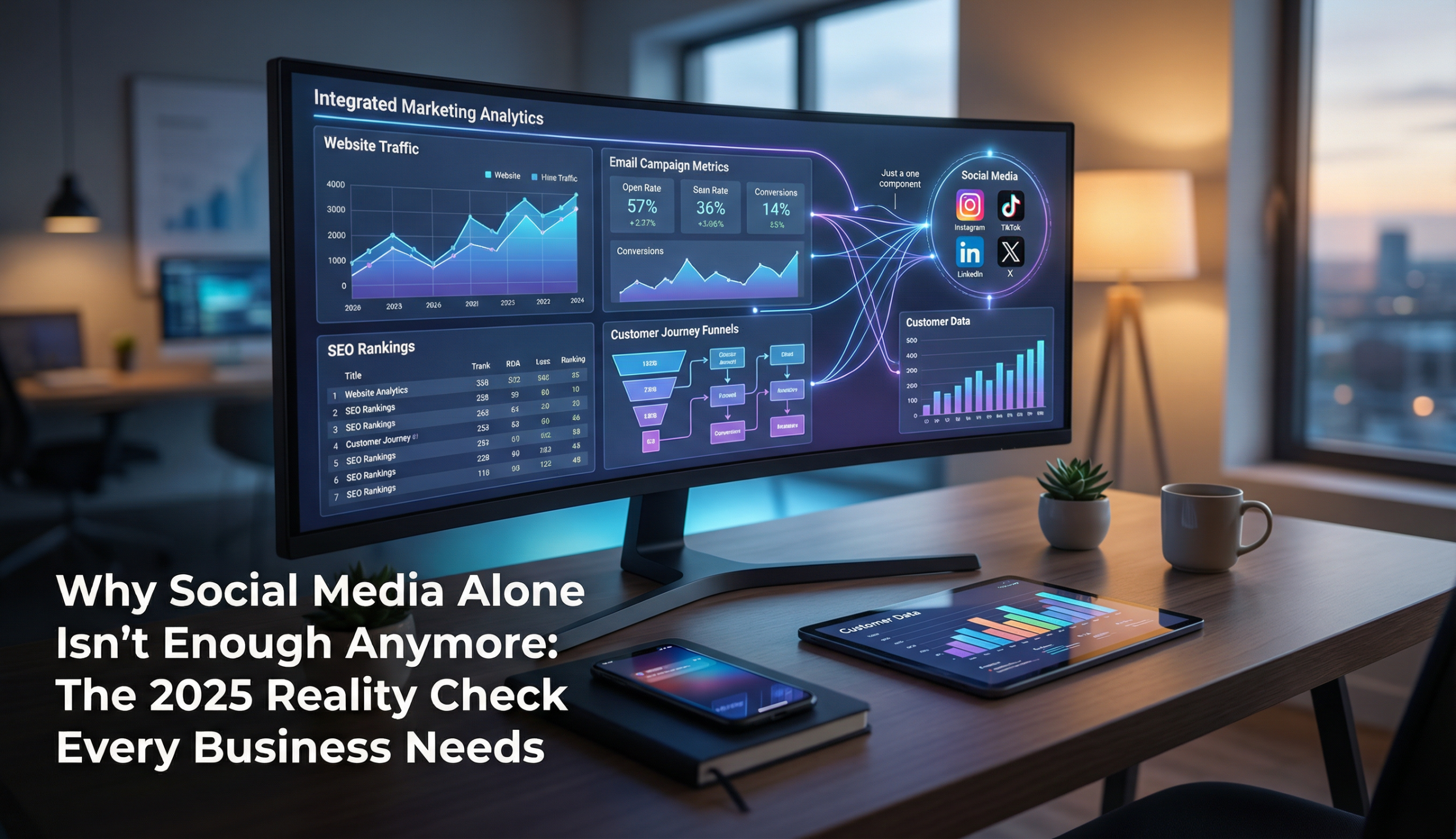
The businesses seeing the strongest growth right now aren’t abandoning social media. They’re putting it in its proper place—as one component of a much broader, more integrated digital ecosystem.
At MetaV8Solutions, we’ve been tracking what’s working across dozens of client accounts and hundreds of campaigns. The pattern is clear: success in 2025 requires an omnichannel approach that meets customers where they are, builds trust through multiple touchpoints, and doesn’t put all eggs in anyone else’s basket.
Let me break down the key elements.
Owned Media as the Foundation
The smartest businesses right now are doubling down on assets they actually own and control.
Your website isn’t just a digital brochure anymore—it’s the hub of your entire marketing ecosystem. If your website hasn’t been updated since 2021, you’re fighting with one hand tied behind your back. Modern websites need to be fast, mobile-optimized, conversion-focused, and built with both user experience and search engines in mind.
More importantly, your website needs to offer genuine value. The days of putting up some service pages and hoping for the best are long gone. Content marketing—real content that addresses your audience’s questions, challenges, and needs—has become the foundation of sustainable organic traffic.
Email lists are experiencing a major renaissance. Yes, email. That thing people have been declaring dead for twenty years. Here’s the truth: email remains one of the highest-ROI marketing channels available, and businesses are finally recognizing why.
You own your email list. Nobody can take it away from you. No algorithm change can prevent your messages from reaching your subscribers. And when someone has given you permission to enter their inbox, you have an attention opportunity that social media simply can’t match.
The open rates for well-crafted email campaigns consistently outperform social media engagement rates by an order of magnitude. And the conversion rates? Not even close.
First-party data has become invaluable. With third-party cookies going away and privacy regulations tightening, the businesses that have been collecting and intelligently using their own data have a massive competitive advantage. Your customer database, your website analytics, your email engagement data—these are strategic assets that will only become more important as we move into 2026.
Search Is Having a Moment (Again)
Here’s something that might surprise you: despite all the talk about SEO being “dead” or “dying,” organic search remains one of the largest sources of high-intent traffic for most businesses.
Think about the psychology. When someone searches for something related to your product or service, they’re actively looking for solutions. They have intent. They want to find something. That’s fundamentally different from someone passively scrolling through their Instagram feed.
Yes, SEO has changed dramatically. The rise of AI-generated content has made Google more sophisticated in identifying and rewarding genuinely helpful content. Voice search, local search, and featured snippets have all changed how people interact with search results. And Google’s own AI integration through Search Generative Experience is reshaping what the search results page even looks like.
But the core principle remains: if people can’t find you when they’re searching for what you offer, you’re invisible to customers at their moment of highest intent.
The businesses winning at search in 2025 aren’t trying to game the algorithm. They’re creating comprehensive, genuinely useful content that positions them as authorities in their space. They’re optimizing not just for keywords, but for user experience and search intent. They’re thinking about search as a long-term investment rather than a quick win.
Paid Media That Goes Beyond Social
Don’t get me wrong—paid social advertising can still be effective. But the smartest advertisers are diversifying their paid media mix.
Google Ads and search marketing remain powerful for capturing high-intent traffic. Someone searching “business consulting services near me” is much further along the buying journey than someone who sees your ad while scrolling Instagram.
Programmatic advertising and display networks have gotten more sophisticated. The targeting options, the ability to retarget across the web, the integration with other marketing channels—it’s become a core part of many successful advertising strategies.
Connected TV and streaming audio are emerging as serious advertising channels for businesses of all sizes. As more people cut the cord and shift to streaming, these platforms are building out advertising options that were previously only available to major brands. Geotargeted streaming ads are becoming surprisingly accessible for local businesses.
Podcast advertising has matured into a legitimate channel. The intimate nature of podcast consumption—people literally putting hosts’ voices into their ears—creates a trust dynamic that’s hard to replicate elsewhere.
The point isn’t to try everything. It’s to understand that paid social is one tool among many, and often not the most efficient one for a given objective.
Content That Does More Than Fill a Feed
Here’s a hard truth about social media content: most of it is disposable. You post something, it gets a little engagement, and within 24-48 hours, it’s essentially disappeared into the ether. The content hamster wheel never stops, and you’re always racing to produce more.
The businesses getting the best returns on their content investment are creating content with longer shelf lives and more strategic purposes.
Cornerstone content pieces that answer fundamental questions in your industry. These become evergreen assets that drive traffic for years, not hours.
Thought leadership content that positions your executives or subject matter experts as genuine authorities. Not shallow LinkedIn posts about “lessons learned,” but substantive insights that couldn’t come from just anyone.
Educational resources—guides, templates, tools, calculators—that provide real utility and give people reasons to remember (and return to) your brand.
Video content that lives beyond social platforms. YouTube videos continue to surface in search results and get views for years after publication. Investing in quality video for your website can improve conversion rates dramatically.
When you create content with multiple purposes in mind—social distribution, SEO value, email nurturing, sales enablement—you get more return from every piece you create.
The 2026 Forecast: What’s Coming Next
Let me put on my prognosticator hat for a moment. Based on the trends we’re tracking right now, here’s what I expect we’ll be talking about this time next year.
AI Will Force a Quality Renaissance
The flood of AI-generated content that started in 2023 isn’t slowing down. If anything, the tools are getting better and more accessible. Every business can now produce passable content at scale.
But here’s the counterintuitive result: as content gets easier to create, genuinely good content will become more valuable, not less.
When everyone can produce mediocre blog posts and social updates by the dozen, the differentiator becomes the stuff AI can’t easily replicate. Original research. Unique perspectives based on real experience. Content that takes genuine risks. Human stories told by humans.
By 2026, I expect we’ll see a clear bifurcation. Businesses that tried to use AI to simply produce more content will be drowning in a sea of sameness. Businesses that used AI to handle the routine stuff while investing in genuinely distinctive human content will stand out.
The platforms themselves will accelerate this. Google is already getting better at identifying and deprioritizing AI-generated content that doesn’t add unique value. Social algorithms will likely follow suit.
Privacy Changes Will Accelerate First-Party Data Importance
The regulatory environment around data privacy continues to tighten. The EU remains aggressive, but we’re seeing momentum in the US and other major markets as well. Between regulations and platform-level changes (like Apple’s ongoing privacy initiatives), the ability to track and target people across the web using third-party data is eroding.
By 2026, the businesses that have built strong first-party data assets—their own customer databases, robust email lists, engaged communities—will have an enormous competitive advantage over those still relying on platform targeting.
If you’re not actively working to build your first-party data capabilities right now, you’re going to be scrambling to catch up.
Social Commerce Will Continue Growing—But Won’t Replace Traditional E-commerce
Buying directly through social platforms is becoming more seamless, and social commerce numbers continue to grow year-over-year. But I don’t think we’re heading toward a world where everyone buys everything through Instagram.
The limitations are real. Product discovery through social is serendipitous, not search-based. The purchase experience on most platforms is still clunkier than dedicated e-commerce. And trust remains an issue—people are warier about entering payment information into social apps than into established e-commerce platforms.
By 2026, social commerce will be a meaningful channel for certain types of products (fashion, beauty, impulse purchases), but for most businesses, it will remain supplementary to traditional e-commerce, not a replacement for it.
The “Authenticity Premium” Will Grow
After years of polished, branded content dominating social feeds, we’re seeing a swing toward rawer, more authentic content. Brands that feel too corporate, too polished, too “brand-ish” are experiencing higher scroll-past rates.
This isn’t new, exactly—authenticity has been a marketing buzzword for years. But by 2026, I think we’ll see this become more pronounced. The brands winning attention will be those that find ways to feel genuinely human in their communication.
This creates an interesting challenge for larger businesses. Scaling “authenticity” is inherently contradictory. Some will solve this by empowering individual employees to become brand voices. Some will solve it by embracing imperfection and behind-the-scenes content. Some won’t solve it at all and will struggle accordingly.
The Fragmentation Will Get Worse Before It Gets Better
If you were hoping for some consolidation in the platform landscape, I have bad news. We’ll likely see continued fragmentation heading into 2026. The pattern of a new platform capturing attention, followed by brand rush to be present there, followed by a chase for organic reach before monetization kicks in—that pattern will continue.
What this means strategically: businesses need to stop trying to be everywhere and get smarter about which platforms actually matter for their specific audience and objectives. Platform evaluation needs to become an ongoing discipline, not a set-it-and-forget-it decision.
Building Your 2026-Ready Marketing Ecosystem
Alright, enough about what’s not working and what’s coming. Let’s talk about what you should actually do about it.
Building a marketing ecosystem that isn’t dependent on social media doesn’t happen overnight. It requires strategic thinking, investment, and patience. But the sooner you start, the better positioned you’ll be as the shifts continue.
Step One: Audit Your Current Dependencies
Start with an honest assessment of where you are right now.
What percentage of your leads or sales come from social media channels? What would happen to your business if those channels disappeared or became significantly less effective tomorrow?
I’ve had conversations with business owners who couldn’t answer these questions because they’d never separated their social media efforts from their overall marketing performance. They had a vague sense that “social media brings in business” but no real clarity on how much or how efficiently.
Get clarity on this. You need to understand what you’re actually getting from each channel to make smart decisions about where to invest.
Also assess your owned assets:
- How healthy is your email list? When’s the last time it grew meaningfully? What are your open and click rates?
- How is your website performing? What’s your organic search traffic trend? How well does the site convert visitors to leads?
- What content assets do you have that continue generating value over time?
- What first-party data are you collecting and how are you using it?
This audit will probably reveal some uncomfortable truths. That’s okay. You can’t fix what you don’t acknowledge.
Step Two: Strengthen Your Foundation
Before you can diversify your marketing, you need strong foundational assets.
If your website is outdated, slow, or conversion-poor, that needs attention first. Driving traffic from any channel to a weak website is like filling a bucket with holes in it.
If your email marketing is an afterthought—or worse, nonexistent—build it up. Create genuine value that people want to subscribe to. Develop sequences that nurture subscribers over time. Make email a strategic channel, not just an occasional newsletter.
If you’re not creating substantial content for your website, start. This isn’t about cranking out blog posts because someone told you to blog. It’s about systematically addressing the questions and needs your potential customers have, building a library of resources that establishes your expertise and draws organic traffic.
These foundation-building efforts don’t produce immediate results. That’s frustrating in a world where social media offers instant gratification metrics. But they compound over time in a way social presence doesn’t.
Step Three: Diversify Your Traffic Sources
Once your foundation is solid, work on building multiple pathways for potential customers to find you.
If you’re not showing up in organic search for your core terms, develop an SEO strategy. This is a long game—expect to invest for months before seeing significant results—but the payoff is traffic that keeps coming without ongoing ad spend.
Explore paid channels beyond social. Test Google Ads if you haven’t. Look at whether programmatic display makes sense for your business. Consider podcast sponsorships or other emerging opportunities.
Build partnerships and referral networks. Word-of-mouth and referral business tends to convert at higher rates and cost less than paid acquisition. How can you systematically generate more of it?
Each new traffic source you develop reduces your dependency on any single channel and makes your business more resilient.
Step Four: Use Social Media Strategically, Not Desperately
Notice I’m not saying abandon social media. I’m saying put it in its proper context.
Social platforms can still serve important purposes:
- Brand awareness for new audiences
- Community building for existing customers
- Remarketing touchpoints in a longer customer journey
- Social proof and credibility signals
- Traffic driving to your owned properties
The key shift is from treating social as your primary customer acquisition channel to treating it as one touchpoint among many.
This actually frees you up to use social more effectively. When you’re not desperately trying to make social media generate all your business results, you can focus on what it does well—building brand affinity, engaging with customers, showing the human side of your company—without the pressure of trying to make it do everything.
Step Five: Build Systems for Integration
The most effective marketing ecosystems in 2025 aren’t just multi-channel—they’re integrated. The channels work together, each playing a role in the customer journey.
A potential customer might discover you through a social ad, visit your website to learn more, download a resource in exchange for their email, receive nurturing emails over several weeks, search for you directly when they’re ready to buy, and convert through your website. That’s not a social media customer or an email customer or a search customer—it’s a customer who touched multiple channels along their journey.
Building these integrated systems requires:
- Consistent messaging across channels
- Proper tracking and attribution to understand how channels work together
- Marketing automation to nurture leads across touchpoints
- CRM integration to maintain visibility into the full customer journey
This is where working with a strategic partner often makes sense. Building and maintaining an integrated marketing ecosystem requires skills across multiple disciplines—web development, content creation, SEO, paid media, automation, analytics. Few businesses can build all those capabilities in-house.
The Human Element: What Technology Can’t Replace
I want to take a step back and address something that sometimes gets lost in conversations about marketing strategy and technology.
At the end of the day, marketing is about humans. It’s about understanding what people need, communicating value in a way that resonates, and building relationships that lead to business.
All the channels, platforms, and technologies we’ve discussed are just tools to facilitate that fundamentally human exchange.
The businesses that will thrive as we move into 2026 and beyond are those that never lose sight of this. They use technology and automation to handle the routine stuff, freeing up bandwidth for the genuine human connection that no algorithm can replicate.
They invest in understanding their customers deeply—not just their demographics and behaviors, but their aspirations, fears, frustrations, and dreams. They create marketing that speaks to those human realities, not just transactions.
They build teams of real people who care about serving customers, and they empower those people to bring humanity to every customer interaction, whether it’s a support ticket, a sales call, or a piece of content.
This isn’t soft, squishy stuff that’s nice but not important. It’s actually the hardest competitive advantage to replicate. Technology can be copied. Tactics can be duplicated. But a genuine culture of customer-centricity and authentic human connection? That’s rare, and it shows.
Common Objections (And Why They Don’t Hold Up)
In conversations with business owners about diversifying beyond social media, I hear the same objections repeatedly. Let me address a few.
“But all my competitors are on social media.”
Yes, and they’re all fighting for the same declining organic reach and paying the same inflated ad prices. Being where your competitors are isn’t a strategy—it’s just keeping up. The question isn’t whether to be on social, it’s whether to rely on it exclusively. And in that context, the businesses that diversify are creating advantages their competitors haven’t thought of yet.
“My audience lives on social media.”
Your audience also uses search engines. They have email inboxes. They consume content on other websites. They listen to podcasts and watch YouTube. They talk to friends and colleagues. Reducing your audience to their social media presence underestimates them and limits your opportunities to reach them in different contexts where they might be more receptive.
“We don’t have the budget to diversify.”
This one deserves a longer conversation, because in many cases it’s actually backwards. Social media—especially paid social in 2025—isn’t the cheap option it once was. Many businesses would actually save money by reallocating some social spend to channels with better efficiency.
Additionally, some of the most important investments—building your website, creating evergreen content, growing your email list—are one-time or ongoing modest investments that pay dividends over years. Compare that to social ad spend that needs to be renewed constantly to maintain visibility.
“SEO and content marketing take too long. We need results now.”
I understand the pressure for quick results. But here’s the uncomfortable truth: if you need results now and you’re not getting them from social, what’s going to change if you just do more of the same?
Yes, organic strategies take longer to mature. But every day you delay starting is a day you delay seeing results. And in the meantime, you can still run paid campaigns on multiple channels to drive short-term results while building longer-term assets.
“This all sounds complicated. We just want to post and get customers.”
I get it. The social media promise was simple, and simple is attractive. But business growth was never actually simple—we just convinced ourselves it was for a while.
The complexity is coming whether you embrace it or not. The question is whether you’ll get ahead of it strategically or be forced to react when your current approach stops working.
What We’re Seeing Work at MetaV8Solutions
At MetaV8Solutions, we’ve been helping businesses navigate exactly this transition. Let me share some patterns we’ve observed in what’s actually working for our clients.
Businesses that commit to website excellence see compounding returns. Clients who invest in rebuilding their websites with modern architecture, strong content, and conversion optimization consistently see improvements across all their marketing channels. Better websites mean higher conversion rates from every traffic source—social, search, paid, referral. The website isn’t just a brochure; it’s a multiplier.
Integrated campaigns dramatically outperform channel-specific campaigns. When we coordinate messaging and timing across email, social, search, and paid channels, the results are consistently better than running isolated campaigns on any single channel. The touchpoints reinforce each other. The customer journey becomes coherent rather than fragmented.
Content investments that seem slow at first become self-sustaining over time. Clients who commit to consistent, quality content creation often feel frustrated in months 1-6. The traffic isn’t there yet. The leads aren’t coming. But somewhere around months 6-12, things start to click. The content builds on itself. Organic traffic grows. Leads start coming in without corresponding ad spend. And that momentum continues as long as the content continues.
First-party data capabilities are becoming decisive competitive advantages. Clients who’ve built robust customer databases and email lists can pivot quickly when platforms change. They’re less dependent on third-party targeting. They have direct lines of communication with their audiences. And they have insights into their customers that platform data can never provide.
Looking Forward
We’re at an inflection point in digital marketing. The strategies that worked from 2015-2022 are increasingly ineffective. The playbooks need to be rewritten.
This isn’t about doom and gloom. It’s about opportunity. The businesses that adapt faster and smarter will gain advantages over competitors still clinging to outdated approaches. Every market shift creates winners and losers, and the winners are usually those who see the change coming and position themselves accordingly.
Social media isn’t going away. It will remain a meaningful part of most businesses’ marketing mixes for the foreseeable future. But its role is changing—from centerpiece to component, from primary to supporting, from destination to touchpoint.
The businesses that thrive in 2026 and beyond will be those that understand this shift and build marketing ecosystems that aren’t dependent on any single platform, channel, or tactic. They’ll own their audiences rather than renting them. They’ll build assets that appreciate over time rather than requiring constant replenishment. They’ll meet customers across multiple touchpoints rather than betting everything on one channel.
It’s not the easiest path. It requires more strategic thinking, more investment, and more patience than the “just post and pray” approach. But it’s the sustainable path. It’s the path to real, durable competitive advantage.
And honestly? It’s the path to marketing that actually feels less frantic and more purposeful. When you’re not scrambling to keep up with the content hamster wheel, constantly anxious about algorithm changes, and watching your ad costs creep up quarter after quarter, there’s space to do marketing that’s actually satisfying. Marketing that builds something. Marketing that creates genuine value rather than just noise.
That’s the opportunity in front of you right now. The only question is what you’re going to do about it.
Where to Start: Your Next Steps
If this article has convinced you that your marketing strategy needs a broader foundation, here’s what I’d recommend as next steps.
First, take an honest inventory. Look at your last twelve months of marketing performance. Where are your leads and customers actually coming from? What are you spending on each channel versus what you’re getting back? If you disappeared from social media tomorrow, what would actually happen to your business?
Second, assess your owned assets. When’s the last time your website was meaningfully updated? How healthy is your email list? What content assets do you have that continue generating value? Where are the gaps?
Third, educate yourself on the alternatives. If you’ve been social-focused, you might not have deep knowledge about SEO, email marketing, paid search, or marketing automation. Start learning. Understand what’s possible.
Fourth, get a strategic perspective. Sometimes you’re too close to your own business to see clearly. An outside perspective—whether from a trusted peer, an advisor, or an agency partner—can identify opportunities and blind spots you might miss.
Fifth, start building. Pick one area where you’re underinvested—maybe it’s content, maybe it’s email, maybe it’s your website—and start making it stronger. You don’t have to do everything at once. But you do have to start.
The businesses that take these steps now will be dramatically better positioned a year from now. The businesses that wait will be having the same frustrated conversations about why social media isn’t working anymore—except the competitive gap will be even wider.
The choice is yours.
At MetaV8Solutions, we help businesses build integrated marketing ecosystems that don’t depend on any single channel. If you’re ready to diversify beyond social media and create sustainable growth, we’d love to talk about what that might look like for your business. The strategies that will win in 2026 are built today.
 🚀 Crafting websites that perform, impress & convert. From sleek designs to full digital strategies, we help brands grow online. 💻 Web Design | SEO | Branding | Hosting | Maintenance. Your 24/7 digital marketing engine starts here.
0 Comments